
You can memorize the finished picture, or you can learn to derive it from scratch. Deriving takes about ten minutes with a pencil and a periodic table, and it holds up under exam pressure. The CO2 Lewis structure is O=C=O: a central carbon atom joined to two oxygen atoms by two double bonds, with two lone pairs on each oxygen and none on carbon. It uses all 16 valence electrons, gives every atom a complete octet and a formal charge of zero, and is linear with a 180° bond angle.
By the end of this walkthrough you will be able to draw that diagram from scratch, prove it with formal charge, test it against a measured bond length, and read the geometry, hybridization and polarity directly off your own drawing. Difficulty: beginner. This has no exceptions to memorize.
What does the CO2 Lewis structure look like?
It looks like this: O=C=O, with two pairs of dots above and below each oxygen, and nothing on the carbon. Two short parallel lines on each side — a double bond each — and a straight line through all three atoms.
The structure at a glance: bonds, lone pairs, and octets
Structurally speaking, we’re looking at bonds, lone pairs, and octets.
- Bonds: 2 sigma bonds and 2 pi bonds (one sigma plus one pi in each C=O double bond)
- Bonding pairs: 4
- Lone pairs: 4 in total — 0 on carbon; 2 on each of the oxygen atoms
- Electrons used: All 16, none left over
Carbon dioxide has no exceptions. There is no expanded octet, no odd electron, no special case. Every atom has an octet.
One thing worth checking before you copy anything onto a worksheet: make sure you are drawing the right species. CO2 is neutral carbon dioxide with 16 valence electrons. “Co2−” is cobalt, not two oxygens. Carbon monoxide (CO) and the carbonate ion (CO32−) are different molecules with different electron counts and different shapes. The O=C=O answer does not transfer to any of them.
Before you start: the 16-electron budget and a central carbon
Before we begin: a central carbon and a 16-electron limit. You need two facts and a blank page. That is the entire prerequisite list.
Fact one: the electron budget is 16. Carbon sits in Group 14 and brings 4 valence electrons. Each oxygen sits in Group 16 and brings 6. So 4 + 6(2) = 16 valence electrons, which is 8 pairs to place. Every step below places or re-uses those 16. You never add to them and never throw any away. The common slip is counting 20 or 24 by including inner-shell electrons — only valence electrons count.
Fact two: carbon is centrally located. The least electronegative atom is center-located. According to the Pauling scale, oxygen is 3.44 while carbon is 2.55. Also, carbon is the most deficient in achieving a full octet, lacking 4 electrons, compared to oxygen which is lacking 2 electrons. Therefore, carbon must be centrally located and oxygen must be on the ends as a terminal atom.
You can write the skeleton as O—C—O before placing a single electron.
How do you draw the Lewis structure of CO2 step by step?
There are a few rules. Just keep in mind that this is the standard procedure set forth by the FSU chemistry department in its molecular structure lab background. The main rules are as follow: count electrons, select the least electronegative atom to be the center, connect the atoms with single bonds, finish the valence shell (or outer octet), and finally, create multiple bonds to satisfy the octet of the central atom. This is not a shortcut specific to drawing the Lewis Structure of CO2.
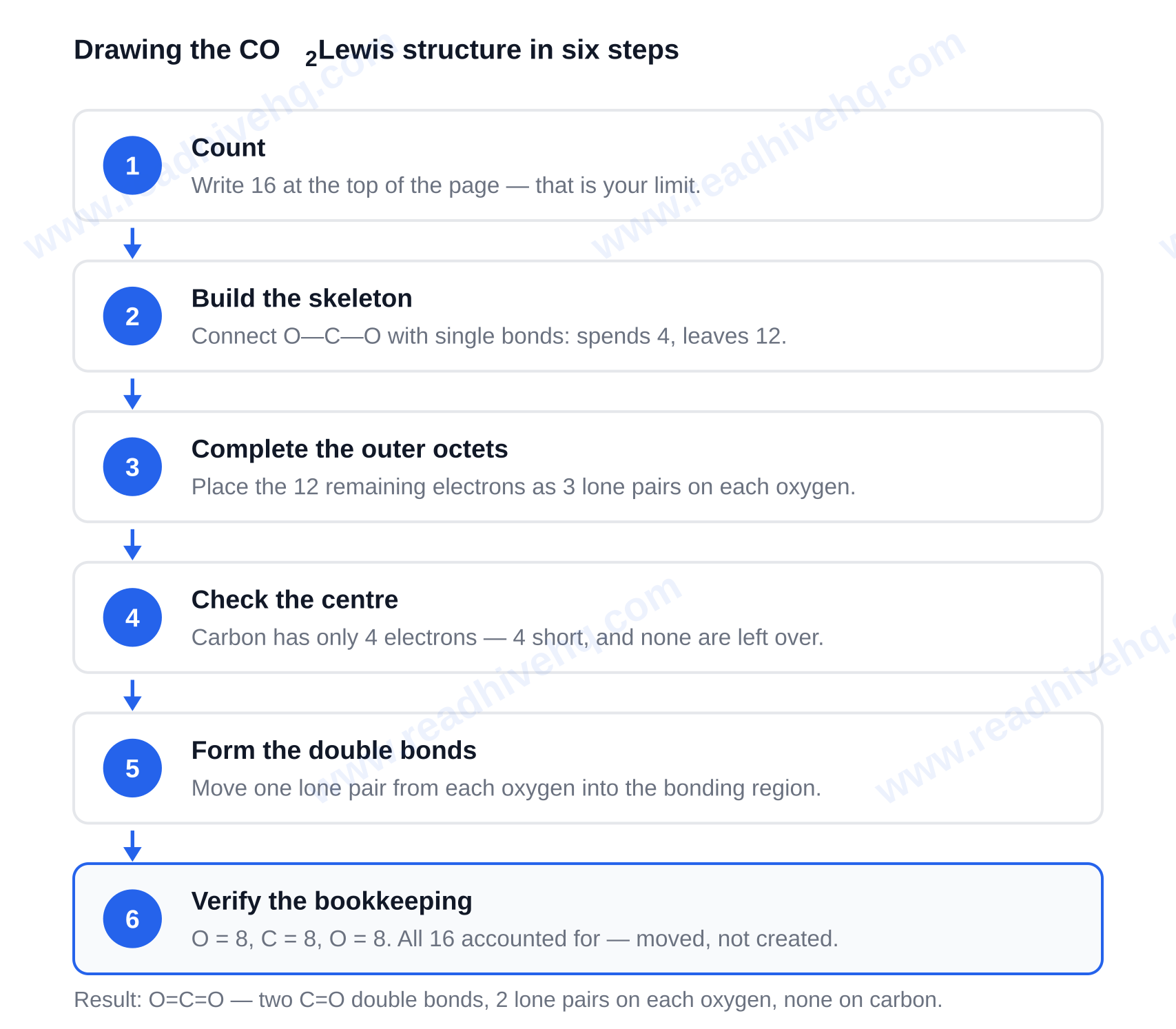
- Count. At the top of your paper, write “16” and no more. This is your limit.
- Build the skeleton. Connect O—C—O with single bonds. That spends 4 electrons (2 bonding pairs) and leaves 12.
- Complete the outer octet. Put the remaining 12 electrons as three lone pairs on each oxygen. Each oxygen now has 8 electrons. The 12 electrons are accounted for, and the limit of 16 is reached.
- Check the centre. Carbon is surrounded by just 2 single bonds — only 4 electrons — and is therefore 4 electrons short of an octet, and you have no electrons left to give it.
- Form the double bonds. Move one lone pair from each oxygen into the bonding region between it and the carbon. You now have two C=O double bonds.
- Verify the bookkeeping. O=8, O=8, and C=8. All 16 electrons are accounted for — you moved them, you did not create them. Nice work!
Which wrong CO2 structure did you draw?
This is the part the ranking tutorials skip. If your drawing doesn’t match O=C=O, find it in the table below and read off exactly which rule it breaks. In practice almost every wrong answer is one of these four shapes.
The four failure modes and the rule each one breaks
| What you drew | What it gets right | Rule it breaks | Fix |
|---|---|---|---|
| O—C—O with three lone pairs on each oxygen | All 16 electrons placed; both oxygens have full octets | The octet rule at the central atom — carbon has only 4 electrons | Convert one lone pair on each oxygen into a bonding pair |
| O—C≡O | Every atom has a full octet and all 16 electrons are used — it passes the octet test, which is why students submit it and defend it | Nothing, on the octet test. Formal charge is what exposes it: −1 on the single-bonded oxygen, +1 on the triple-bonded oxygen | Keep it as a minor resonance contributor; submit the symmetric form as the answer |
| Oxygen in the middle (C—O—O or O—O—C) | Often the right electron count | Central-atom selection — the least electronegative atom takes the centre, and carbon (2.55) is less electronegative than oxygen (3.44) | Redraw the skeleton as O—C—O and start again |
| CO2 drawn with a charge, or with only 10–14 electrons placed | Usually the right skeleton | The electron budget — CO2 is neutral, so the count is exactly 16 | Recount from the group numbers: 4 + 6 + 6 |
The order to apply the tests: electron count, then octet, then formal charge
Run the tests in this sequence and the answer settles itself. First count electrons — all three serious candidates have 16, so electron count cannot discriminate between them. Then test the octet, which eliminates the all-single-bond form. Then test formal charge, where O=C=O comes out 0/0/0 and wins.
The single most common mistake: trusting the octet rule alone
Here is the point almost no page states plainly. The Octet Rule is not enough to choose the structure of CO2 because the triple bond form satisfies every Octet as well. The deciding factor is Formal Charge. Students that stop at “all my octets are full” hand in the O—C≡O structure and lose the mark thinking they were right.
Working the formal charge on carbon and on each oxygen
Working the formal charge on the carbon and each of the two oxygens starts with one expression. The standard formula is: formal charge = valence electrons − nonbonding electrons − ½(bonding electrons).
For carbon in O=C=O: 4 − 0 − ½(8) = 0. For each oxygen: 6 − 4 − ½(4) = 0. Every atom carries zero formal charge, which is the signature of the most stable arrangement.
The three resonance structures and the major contributor
CO2 has three resonance structures: the symmetric double-bonded form plus the two single-bond/triple-bond forms. As the resonance analysis on topblogtenz sets out, those two asymmetric forms carry −1 on the single-bonded oxygen and +1 on the triple-bonded oxygen, so they are only minor contributors. The real structure of CO2 is a resonance hybrid of all three structures, dominated by the zero-charge symmetric form.
If an exam asks which structure is the major contributor, answer in one line: The one with the smallest formal charges, and if there are negative formal charges, place it on the more electronegative atom.
Check your work: the 116 pm bond-length test
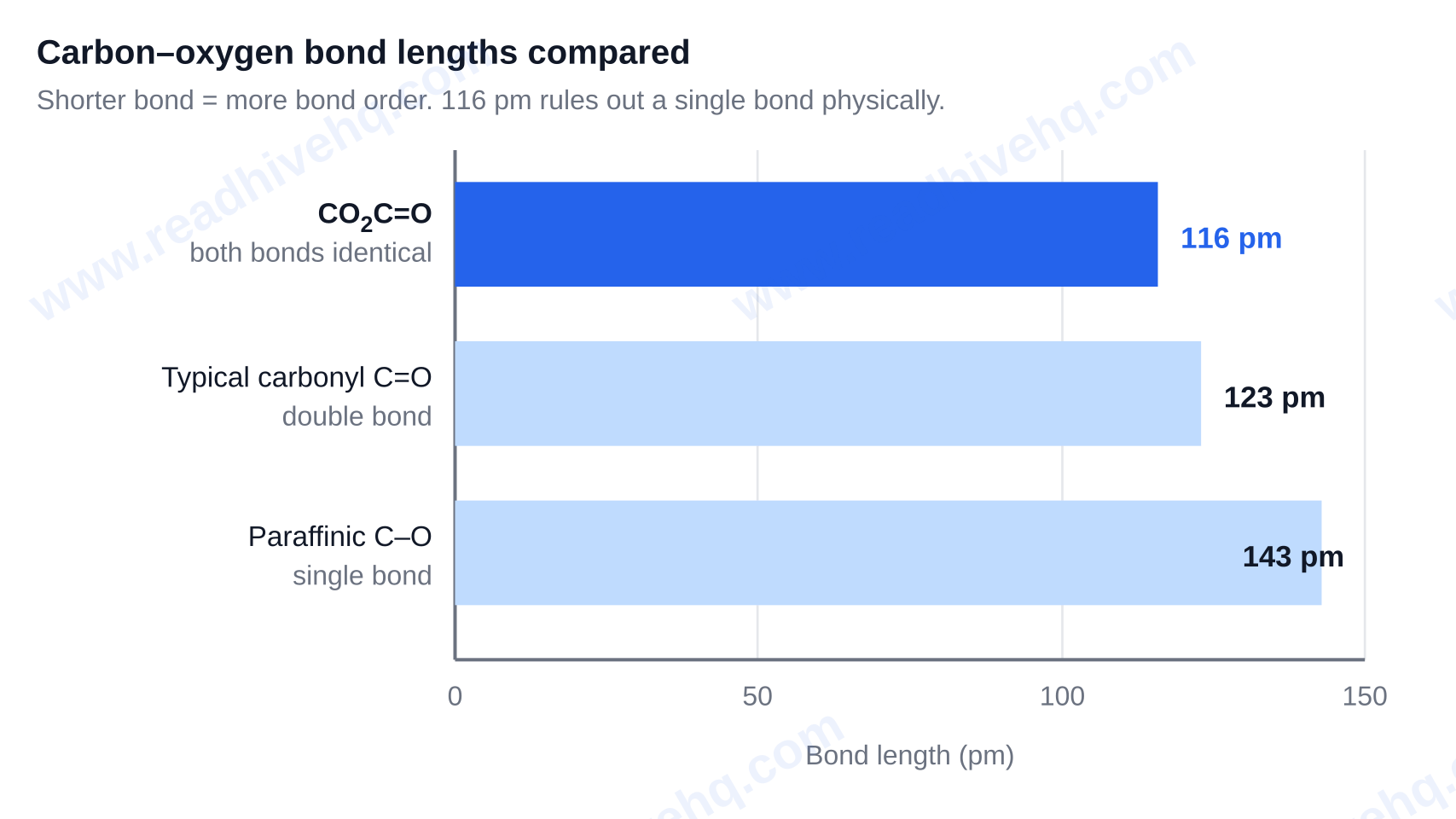
You’ve probably done most of the reasoning on paper, but let’s check your work with the 116 pm bond length test. Octets and formal charges are rules we apply to a diagram. The experimental test is bond length, and it is the quickest way to confirm you haven’t just drawn something nice and tidy.
Wikipedia’s carbon–oxygen bond data gives the C=O bond length in carbon dioxide as 116 pm. A paraffinic C–O single bond runs about 143 pm. A typical carbonyl C=O is around 123 pm. So 116 pm is far too short to be a single bond — it rules out the all-single-bond structure physically, not just on the octet argument.
The second half of that measurement is the part people miss: both bonds in CO2 are identical at 116 pm. That is exactly what the symmetric O=C=O predicts. The asymmetric single-bond/triple-bond resonance forms would require two different bond lengths, and the molecule does not have them. The drawing matches the measurement, which is the strongest thing you can say about a model.
What are the geometry, bond angle, and hybridization of CO2?
Bond angle is always 180 degrees, and hybridization is always sp. The geometry falls out of the diagram you just drew. So, since there are two domains around carbon, with no lone pairs, it is classified as an AX2 VSEPR system.
Why the electron geometry and molecular geometry are the same
Because there are no lone pairs on carbon, they are both linear. If there are lone pairs on the central atom, that is the only time electron geometry and molecular geometry are not the same. The bond angle is 180°, because two electron domains repel each other to the maximum separation available.
Why carbon is sp hybridized and not sp2
Two domains means one s orbital and one p orbital are hybridized, making it sp hybridized. The other two pi bonds are satisfied by the two leftover p orbitals. Look at your diagram, and see that the 2 sigma bonds are from the sp hybrids, and the 2 pi bonds are from the leftover p orbitals. Count the domains, not bonds. That’s what people are usually doing when they write sp2.
Is CO2 polar or nonpolar?
Nonpolar — and the reasoning matters more than the answer. Each C=O bond is genuinely polar: oxygen (3.44) pulls electron density away from carbon (2.55), an electronegativity difference of 0.89. So you have two real bond dipoles.
But CO2 is a linear molecule. The two bond dipoles are equal in magnitude and point in exactly opposite directions, 180° apart. As Chemistry LibreTexts describes in its treatment of polar covalent bonds and dipole moments, a molecule’s dipole moment is the vector sum of its individual bond dipoles — and for CO2 that sum is zero. Net dipole moment μ = 0.
A more generalizable rule is worth more than the fact: molecular polarity relies on geometry as much as it relies on the types of bonds. CO2 is the prototype of a non-polar molecule comprised solely of polar bonds. Bending the molecule like water would result in those polar bonds not cancelling out.
CO2 Lewis structure: the exam-answer summary
Compare your answer to this Summary at a Glance.
- Total valence electrons: 16
- Lewis structure: O=C=O, two C=O double bonds
- Lone pairs: 4 total, 2 on each O, 0 on C
- Bonds: 2 σ, 2 π
- Formal charge: 0 on C, 0 on each O
- Electron geometry: linear. Molecular geometry: linear. VSEPR notation: AX2
- Bond angle: 180°
- Hybridization of C: sp
- Bond length: 116 pm, both bonds identical
- Polarity: Nonpolar; net dipole moment, μ = 0
- Resonance: 3 structures, with the symmetric O=C=O as the major contributor
Conclusion: derive it, don’t memorize it
Nothing beyond the basics of organizing the valence electrons is memorized. Count 16 electrons, the center of symmetry is occupied by the least electronegative atom (C), the outer orbitals are completed (O), and C acquires a complete octet via double bonds. Formal charge is used to confirm rather than the octet rule. The answers to everything else (e.g. linear, 180°, sp and nonpolar) can be found in that single representation, which is why the CO2 Lewis structure is better derived rather than memorized.
Your next action: close this page, redraw O=C=O from blank paper, and calculate the formal charge on all three atoms yourself.
Rule of thumb: If formal charges are 0/0/0, structure is correct. For other pieces in this vein, see Read Hive HQ.