


17 out of 20 as a percentage is exactly 85%. Divide 17 by 20 to get 0.85, then multiply by 100. 85% is a B on the US grading scale. Most people stop there. However, and this is the main reason for this page, a score written as 17/20 commonly comes from a 0–20 marking scheme where 17 sits in the top band.
Run the number through Calculatio, an EZ Grader clone, or any of the grade calculators on the first page of results, and you get the same two outputs every time: 85%, B. The arithmetic is right. The calculator has no way of knowing which scheme you’re using, so that "B" is an educated guess dressed up as a fact. Below is the maths first, then the fork that actually decides your answer.
How do you calculate 17 out of 20 as a percentage?
Two ways. One is the long way, the other is the short way.
The formula and the long way: (17 ÷ 20) × 100
The formula for a percentage is (part ÷ whole) × 100. Here, 17 is the numerator and 20 is the denominator. 17 divided by 20 is 0.85, and 0.85 multiplied by 100 is 85%. The decimal equivalent is 0.85. The fraction 17/20 is already in its lowest terms, so there is nothing to simplify — and 85 is exact, so there is nothing to round.
The 30-second shortcut: scale the fraction to /100
This is the step the calculator pages leave out, and it’s the one I’d teach a student first. A percentage is just a fraction expressed out of 100, and 20 × 5 = 100. So multiply both parts by five: (17 × 5) / (20 × 5) = 85/100 = 85%. No division, no tool, no rounding decision.
How to convert any score out of 20
Scaling works for any quiz length. Multiply by 5 to convert a score out of 20, by 4 for a score out of 25, by 2 for a score out of 50. So 13/20 becomes 65/100 = 65%. 19/20 becomes 95/100 = 95%. Once you see it, you stop reaching for a calculator for any of these.
Some common mistakes include multiplying by 100 before dividing, reading "17/20" as 17%, and adding decimal places to an answer that is already exact (85%, not 85.00%).
What letter grade is 85%?
In the US there are two main grade scales. The first is the simple 10-point scale, with the 80–89% range being a B. The second is a plus/minus scale, where a grade is shaved or bumped by the plus/minus — and according to the grade percentage chart published by EasyGraderHub, the bands sit like this:
- B- — 80–82%
- B — 83–86% (85% lands here)
- B+ — 87–89%
So 85% is a B on both US scales — and it is not a borderline B, it sits mid-band. It is two percentage points above the floor of the B band and two below the B+ cutoff. One wrong answer more would have cost you the letter, not just the number.
What is 17 out of 20 as a GPA?
Traditionally, a B is a 3.0 (unweighted, out of 4.0). Cut-offs vary between schools and teachers, so treat these bands as defaults: the 3.0 holds only if the 85% reading is the right one for your score in the first place.
Why “17/20 = B” is the wrong answer for a lot of readers
This is where I disagree with every page that is currently ranking for this query. They all answer the arithmetic question. Almost no one typing the question is only interested in the arithmetic answer.
The one question that decides it: 20 questions, or a mark out of 20?
The decision rule, in one sentence:
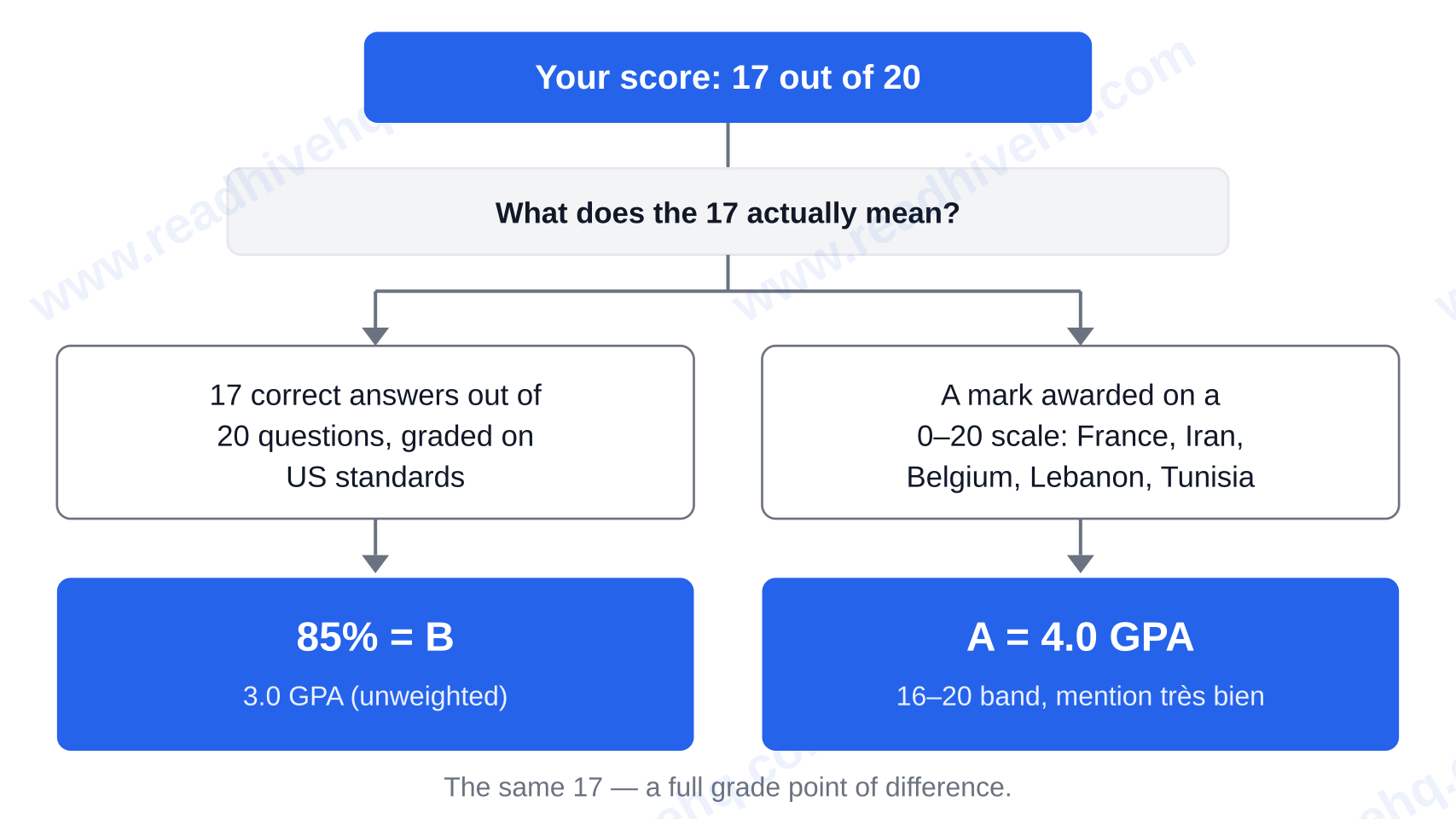
- If your 17 means you got 17 correct answers out of 20 questions on an assessment graded using US standards, then 85% = B is correct.
- If your 17 was a mark awarded on a 0–20 scale, it is an A equivalent, and "B" significantly understates it.
There are two different situations that happen to be expressed the same way. A 0–20 marking system is used nationally in France, Iran, Belgium, Lebanon, Tunisia and elsewhere, and in those systems high marks are deliberately scarce — the scale is not a percentage scale wearing a different hat. So converting a mark to 85% and then to a B applies a US distribution to a score that was never produced by a US system.
How a 17 converts on the 0–20 scale (France, Iran and similar systems)
This is not personal opinion, this is standard credential-evaluation practice. In France, the mention très bien band runs from 16 to 20. As per the AACRAO/IERF evaluator standard and the Sciences Po Strasbourg scale, any grade of 16 or above is converted to a US A (4.0). Elsewhere, Wikipedia’s entry on academic grading in Iran places the grades 16 to 20 in the "A / Upper Class Honors" range with 10 as the pass mark and 17–20 treated as Upper Class Honors at some universities.
So, depending on who you ask, a 17 could be a B (3.0) or an A (4.0). A full grade point of difference hinges on the answer to a question no calculator asks. If your 17 is going on a transcript, an application, or into a credential evaluation, use the national conversion table for that country; do not use a percent calculator or the “85%” you may have found while searching 17 out of 20 as a percentage.
How far was 17 out of 20 from the next grade up?
If you are on the US test side of the fork after seeing 85%, this is probably the question on your mind. The pages ranking for this query stop at the percentage.
With 17/20, you got 3 wrong. Each question in a 20-question test is worth exactly 5% of the total grade. So the grades either side of 17/20 are tightly spaced and entirely predictable. If you gain one more, your score goes up to 18/20 = 90% = A-. If you lose one more, your score goes down to 16/20 = 80% = B-.
Why B+ is impossible on a 20-question test
Put the two facts together — 5% per question, B+ = 87–89% — and you get the conclusion I’ve never seen a calculator page draw: B+ is mathematically unreachable on a 20-question test. The range jumps straight from 85% to 90%, with the entire B+ range falling in the gap. If you’re chasing a B+, a re-mark won’t produce one. You need partial credit (check whether the test allows it), a different assignment, or extra credit. That’s a far more useful thing to know than obsessing over a single letter.
Is 17 out of 20 a good score?
It depends on the system, and anyone telling you otherwise is skipping the hard part. In the US, a solid 85% is above average but mid-range — a mid-B and a clear pass, comfortably short of an A. On a 20-point national scale, a score of 17 out of 20 is superior, high-distinction performance in a band most students never reach. Other factors come into play too, like weighting of the course, class average, grade caps, and how lenient the teacher was when grading.
Here’s how the scores either side compare across systems, so a 16, an 18 — or a cross-country comparison — doesn’t need a second search. US system letter grades follow the plus/minus chart above; the far right column reads the same mark on a 0–20 national scale.
| Score | Percentage | Letter grade (plus/minus) | On a 0–20 national scale |
|---|---|---|---|
| 14/20 | 70% | C- | Below the 16+ A-equivalent band |
| 15/20 | 75% | C | Below the 16+ A-equivalent band |
| 16/20 | 80% | B- | Bottom of the 16–20 A / très bien band |
| 17/20 | 85% | B | A / Upper Class Honors (16–20) |
| 18/20 | 90% | A- | A equivalent (16–20 band) |
| 19/20 | 95% | A | A equivalent (16–20 band) |
| 20/20 | 100% | A+ | A equivalent (16–20 band) |

The bottom line
A 20-question quiz in a US classroom? Take the standard answer and relax: 17 out of 20 as a percentage is 85% — that’s a B, worth 3.0 on an unweighted GPA, and three questions off full marks. A B+ is not an option. A 17 on a report card, transcript or exam paper marked out of 20 in France, Iran or another system like it is not 85%. Ignore the calculators in those cases — they are answering a question you didn’t ask.
Do this next: decide if your 17 means 17 out of 20 correct answers, or if it means a mark out of 20. Then read across the matching row of the table above, and for anything official, refer to that country’s published conversion table to make sure before you write a letter grade anywhere. There’s plenty more to dig into on Read Hive HQ.
People Also Ask
What is 18 out of 20 as a percentage?
18/20 = 90%. Divide 18 by 20 = 0.9. Multiply by 100. Or use the shortcut: (18 × 5)/(20 × 5) = 90/100. 90% is an A- on the plus/minus grading scale in the US. So one extra correct answer lifts a 17/20 from a B to an A-.
What is 17 out of 20 as a decimal?
0.85. Divide the numerator by the denominator: 17 ÷ 20 = 0.85. That decimal is the step before the percentage — multiply it by 100 and you get 85%. Exact, no extra decimals to round.
What is 17 out of 20 in the French grading system?
In the French grading system, 17 falls in the 16–20 range, which carries the mention très bien. Per GPACalculator.net, the AACRAO/IERF evaluator standard as well as the Sciences Po Strasbourg scale convert any French grade of 16 or above to a US A, equal to a 4.0 GPA. This means 17/20 is an A and a 4.0 GPA, not the B that a percentage calculator returns for 85%.