

Words that describe nouns and pronouns beginning with the letter S are called adjectives. Some examples are sweet, smart, strong, sincere, simple, soft, shy, sad, short, safe, silly, sunny and sharp, and so forth. There are a lot of adjectives that start with the letter S because S is one of English’s most frequent word-initial letters.
Finding a lot of words is not the hard part. There are already a lot of lists that provide a long list of adjectives — the ranking lists already offer between 98 and over 1,000 of them, from YourDictionary’s 98-with-definitions up to ESLForums’ 1000+. The hard part is choosing one and sticking with it. Therefore, this list is cut differently; it provides the situation in which the adjectives are used, the near synonyms that are confusing, and the comparative form, which are the three things a 600 word wall of text never provides.
1. The 30 adjectives that start with S you will actually use
Use this list if you need a word that describes a noun or pronoun and starts with the letter S. These 30 words need no dictionary check: sweet, smart, strong, sincere, simple, soft, shy, sad, short, safe, silly, sunny, sharp, slow, small, sleepy, smooth, shiny, special, serious, steady, solid, sore, sour, spicy, stable, straight, strange, stunning, sturdy.
An adjective is a word that modifies a noun or pronoun — Merriam-Webster defines adjectives as words that ascribe a quality or distinguish one thing from another. They can either come before the noun (a serene room) or after the linking verb (the room was serene) in a sentence. That is all the grammar frame you need.
Why does S yield so many? In word initial position, the frequency of the letters s, c, p, d, t is much higher than the frequency of all the other letters. In an analysis by Wolfram, e was identified to be the most frequently occurring letter in English texts; however, s, c, p, d and t are the most frequently occurring letters in the initial position of words. As such, S does punch above its weight in an initial position, and hence, the pool of descriptors is long.
2. Pick by what you’re writing, not by positive or negative
This is the item that wins the page. Every alternative list goes with positive or negative S words, which is the wrong axis of sorting, as you are already aware of your sentiment (positive or negative). What you don’t know is which word is safe in your context. The main issue with that system is context: a word that is technically positive is still a reference letter sinker.
| What you’re writing | Vetted picks | The trap to avoid |
|---|---|---|
| Reference letter or performance review | steadfast, scrupulous, skillful, self-assured, supportive | Sufficient and satisfactory read as faint praise — they damage the person you’re endorsing. |
| Dating or personality profile | sociable, spirited, sincere, sunny, silly | Sophisticated reads as self-flattering when you apply it to yourself. |
| Fiction antagonist | sardonic, sinister, supercilious, servile, shifty | Pick for behaviour the reader can see, not an internal label the narrator asserts. |
| Kindergarten worksheet or early reader | sad, soft, sunny, sticky, sleepy, shiny | Anything over two syllables, or any quality a child can’t point at. |
| Poem, brand name or tagline | serene, silken, sonorous, shimmering, whispering | Three sibilants in a row tips into parody. Two, then a hard consonant. |
| Resume bullet or professional summary | strategic, scalable, streamlined, seasoned | Synergistic is the one to drop — it signals filler, not skill. |
A three second check before you click send: make sure you’ve got the right connotation, check the register, and finally, make sure you know the meaning, using a dictionary entry instead of a word list. A word list is something that proves a word exists; it does not prove its definition.

3. Positive S adjectives, grouped by the quality you’re praising
This is jump to the slot you need, rather than scanning an undifferentiated mass.
- Intellect and judgement: sagacious (keen mental discernment), sage (wise through experience), savvy (shrewd and well-informed), scintillating (brilliantly clever), sharp, sensible, shrewd.
- Character and integrity: scrupulous (careful and morally exact), steadfast (loyal and unwavering), selfless, sincere, staunch, stalwart, straightforward.
- Warmth and social ease: sociable, supportive, sympathetic, sweet, sunny, spirited, self-assured, suave (smoothly charming).
- Skill and achievement: skillful, stellar (outstanding), sensational, spectacular, splendid, successful, seasoned.
- Calm, style and beauty: serene (calm and untroubled), sublime (of outstanding beauty), stunning, stylish, sumptuous (lavish), sophisticated, silken.
Five of these are unsafe straight from a bare list, so here they are in register: Her sagacious reading of the contract saved us a month. He is scrupulous about crediting others’ work. A suave host who never let a conversation stall. The view from the ridge was sublime. They served a sumptuous four-course dinner. Note the pattern. Sagacious and sublime are formal. The most common misfire in this group is dropping them into casual writing.
4. Negative S adjectives, sorted by the flaw being named
Negative words carry more risk, so match force to context. Malice: sadistic, spiteful, sinister, scornful, slanderous. Dishonest: shady, shifty, sneaky, slippery, slimy, specious (superficially plausible but wrong). Weak character: spineless, servile (excessively submissive), slothful, slovenly, sluggish, sloppy, scatterbrained, shortsighted. Social: selfish, snobbish, supercilious (haughtily contemptuous), surly, sour, stingy, stubborn, shallow, shameful.
These are the words most frequently misused, along with examples found in the wild: a servile assistant who agreed with everything; a supercilious nod to the cheaper seats; a specious argument that collapsed with one question; a slanderous post about a former employer; a sardonic shrug to the whole process. One warning worth the ink: calling someone slanderous accuses them of damaging falsehood, not rudeness. If you only mean tone, scornful or surly would be better suited to describe your meaning.
5. The S adjectives that get confused with each other
No ranking page addresses this, though one-page lists this as a question. Word.tips identifies a commonly-confused-S-adjectives FAQ and never addresses it. Here are the adjective pairs that most trip-up writers.
| Pair | The real difference | Test sentence |
|---|---|---|
| Sympathetic / empathetic | Sympathetic feels for you; empathetic feels with you, sharing the experience. | A sympathetic nurse; an empathetic survivor. |
| sensitive / sensitive | Same word, opposite social work: attuned to others’ feelings, or easily offended. Only context disambiguates it. | A sensitive listener vs. too sensitive to tease. |
| sarcastic / sardonic | Sarcastic mocks a person, usually out loud. Sardonic is bitter and detached, usually aimed at a situation. | A sarcastic reply; a sardonic view of office politics. |
| sage / savvy | Sage is wise from experience and reflection. Savvy is practically shrewd. | Sage advice; a savvy negotiator. |
| salubrious / salutary | Salubrious is health-giving, usually air or climate. Salutary produces a beneficial effect, usually a lesson. | A salubrious coastline; a salutary warning. |
| specious / spurious | Specious looks valid and isn’t. Spurious is fake in origin. | A specious claim; a spurious signature. |
| stingy / frugal | Identical behaviour, opposite verdict: stingy judges, frugal approves. | Stingy with tips; frugal with groceries. |
If you’re stuck between the two, pick the word whose meaning you can define in your own words and then check the meaning in a dictionary.
6. How to compare and stack S adjectives correctly
Search by letter and you will end up either stacking or comparing 2 or 3 S words in one phrase. Here are the forms, including common variations.
- Double the final consonant: sad → sadder/saddest, slim → slimmer/slimmest.
- Change y to i: silly → sillier/silliest, shiny → shinier/shiniest. Shy allows both shyer and shier.
- Add -r/-st after a silent e: strange → stranger/strangest, simple → simpler/simplest.
- Use more/most for the longer words: more sincere, most sophisticated, more supportive, most scrupulous. An S specific list leans more toward this type, which could explain the frequency of the error in this case.
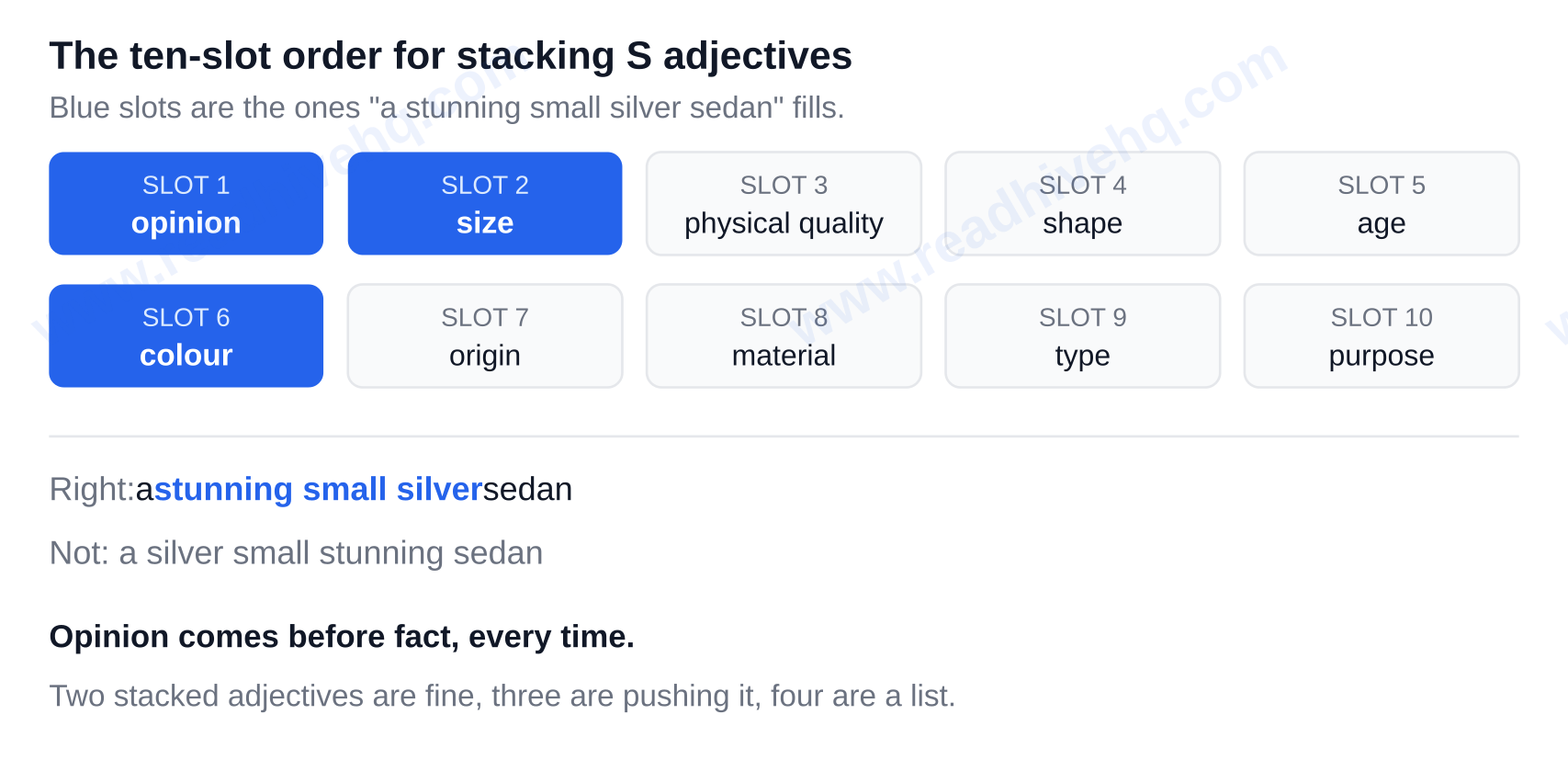
For order, use the ten-slot sequence found in the Cambridge Dictionary: opinion, size, physical quality, shape, age, colour, origin, material, type, purpose. Applied, this results in a stunning small silver sedan (a silver small stunning sedan it is not). Opinion comes before fact, every time. A practical cap (it helps you read cleanly): Two stacked adjectives are fine, three are pushing it, four are a list. Break the list into a second sentence.
7. Why S adjectives sound hushed, smooth or sinister
About half the people who search by letter are hearing a sound, not saying a letter. That sound is called sibilance and describes the repetition of the soft s, sh, z and ch sounds to create a hissing or whispering effect, from the Latin sibilare, ‘to hiss’. It can also be alliteration, but not all sibilance is alliteration. In sibilance, the sibilant can sit mid-word or at the end and still count. Serene and whispers both do.
One scene gives off two vibes, depending on what’s written. Soft and whispered: serene, silken, soothing, subdued, shimmering, silvery. Sharp and sinister: sinister, sly, slithering, scathing, searing, shrill. For a name or tagline, two sibilants beside a hard consonant is clean, while three makes a joke.
8. Easy picks for kids, advanced picks for writers
I’ve sorted opposite ends of the same list in the same place. For kindergarten and beginning readers: sad, sunny, silly, small, soft, slow, sweet, shiny, sleepy, strong, short, smelly, sticky, scary, sandy — each of these should contain one or two syllables, be concrete, and be describable with a picture. Pair each with something the child can see in the room, then ask for the opposite. For adults learning English as a second language or English as a foreign language, the sensory group is the easiest entry point because the meaning is physically checkable.
For writers who want a word nobody else used: sanguine (cheerfully optimistic), soporific (sleep-inducing), sepulchral (gloomy, funereal), Stentorian (loud and powerful), saturnine (gloomy or sullen), sycophantic (flattering for advantage), serendipitous (occurring by happy chance), salubrious, sonorous. The rule: one per passage, and only when the plainer word genuinely loses meaning. Otherwise it reads as showing off. Word-game players, note the short ones — sage, sear, slim, smug, sour, spry and stark carry outsized value in Scrabble and Wordle.
The one pick most readers should make
If you’re describing a person and want a word that works in almost any register — reference letter, profile, eulogy, review — use sincere. It carries no formality risk, no faint-praise problem, and no confusable twin.
Here’s your next step: choose three S adjectives from the use-case table that fit what you’re writing right now, look each one up in Merriam-Webster to confirm the meaning and register, and write one sentence with each. Keep the one that survives. There’s plenty more to dig into on Read Hive HQ.
Frequently Asked Questions
Is ‘s’ a letter that gives more adjectives than any other?
S is among the most productive, though no reliable count crowns a single winner. ‘E’ is actually the most common letter in English text overall; however, Wolfram’s letter-frequency analysis shows that s, c, p, d and t dominate as word-initial letters. So S yields a bigger descriptive pool than its overall frequency suggests. Some published S lists include 98 words with definitions, while others include over 1,000.
What are some three-letter and four-letter adjectives that start with S?
Three letter adjectives: sad, shy, sly. Four letter adjectives: safe, slim, soft, smug, sore, sour, spry, sure, slow, snug, sane, sick. These short forms are best to remember for games like Scrabble and Wordle, and most of them take -er and -est easily; e.g. sadder, slimmer, smugger, sorer. Note the consonant doubling in sadder and slimmer.
Can a word that starts with S be both an adjective and a noun?
Yes, and many common words are like this. For example, sage is both wise (adjective) and a wise person or a herb (noun). Sweet, sour, square and savoury all work either way. Determining the part of speech is easy; it is based on the role the word plays in the sentence; e.g. a square table is an adjective, draw a square is a noun. Check the dictionary entry if you’re unsure.
What is a strong S adjective to use on a resume or in a cover letter?
Impressive options include strategic, seasoned, streamlined, scalable and skillful — each of these is result-oriented rather than a personality claim. Drop synergistic, which reads as filler. Satisfactory and sufficient are technically positive words, but they still land as faint praise, which is worse than saying nothing.
What are positive S adjectives to describe a woman or a man specifically?
The same adjectives can be used to describe a man and a woman — none of these adjectives is gendered in meaning. With regards to either, the best choices are sincere, supportive, sharp, steadfast, spirited, skillful, self-assured and sociable. Know this: habit, not grammar, nudges writers to use appearance words like stunning and stylish for women and achievement words like successful and strategic for men. The best choice is always based on what the person actually did.
How many S adjectives should I use in one sentence?
Two read cleanly, three start to look a little cluttered, and four becomes a list — break it up into a second sentence instead. When combining multiple S adjectives, use the Cambridge Dictionary order: opinion, size, physical quality, shape, age, colour, origin, material, type, purpose. That gives you a stunning small silver sedan, not a silver small stunning sedan. Opinion always comes before factual description.