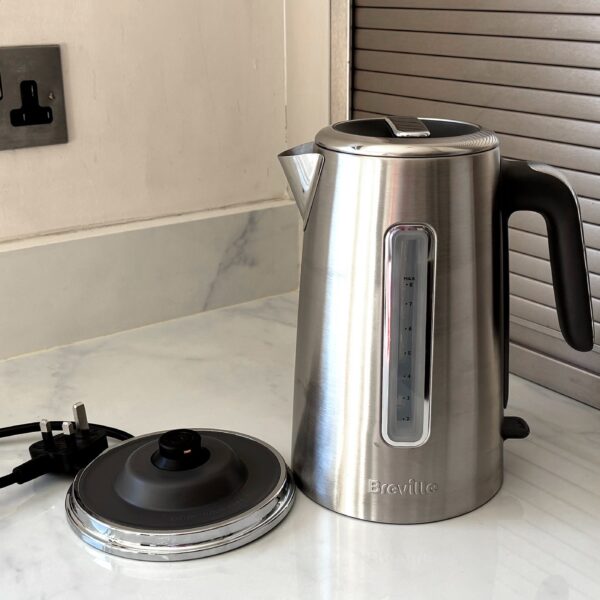

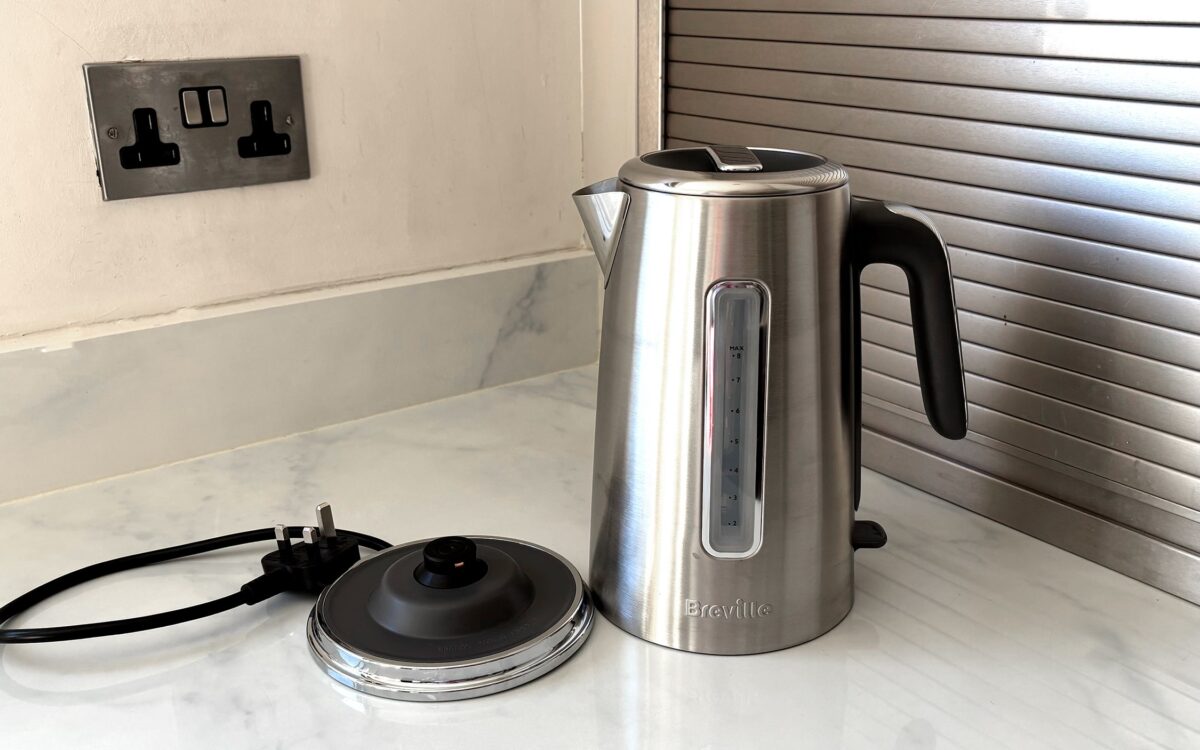
Your 3 kW kettle clicks on, and at the same time, a president signs a bill into law. This example shows how confusing and ambiguous the term ‘power’ can be. So what is power? Power is the capacity to do or affect something, measured against time. In physics, power is measured in watts — one joule per second — and it is the rate at which energy is transferred or work is done. In the social and political sciences, power refers to the ability to affect or influence others or the course of events.
As an example in the physical sciences, a 60 W light bulb draws 60 joules of energy every second it is on. That is all a watt rating ever tells you: how fast something moves energy. Swap the bulb for a 3,000 W kettle and you are moving fifty times more energy per second, which is why a kettle boils in minutes and a bulb could glow for a year without boiling anything.
What is power in simple words?
In simple terms, power is the capacity to do or affect something over a given time — how much can be done, and how fast. Every meaning of the term ‘power’ can be reduced to this generic definition.
Power in one sentence
Three one-liners cover almost every search for this word. In physics and engineering: joules of energy moved per second. In the social and political sciences, power is the ability to affect or influence people or the course of events despite opposition. In mathematics: a number multiplied by itself a set number of times.
What people usually mean when they say power and don’t actually mean are three things. Power is not force (a push or pull, measured in newtons). Power is not strength (i.e. how much force a person can produce). Power is not energy (i.e. the total amount of work available). Power is the rate at which work is done or energy is spent. In other words, power is energy divided by time.
Which sense of power did you mean?
| Sense | Core meaning | Unit or formula | Sounds like |
|---|---|---|---|
| Physics | Rate at which energy is transferred or work is done | watt (W); P = E/t | “It’s a 3 kW kettle” |
| Mechanics | Force applied at a speed, or torque at a spin rate | P = F·v; P = τ·ω | “Peak power at 6,000 rpm” |
| Electrical engineering | Rate electrical energy is delivered or dissipated | P = V·I; P = I²R = V²/R | “That resistor dissipates 2 W” |
| Utility supply | The electricity itself | Billed in kilowatt-hours (kWh) | “The power went out” |
| Mathematics | Exponentiation | xⁿ — x multiplied by itself n times | “The third power of 2 is 8” |
| Social and political | Capacity to carry out your will despite resistance | No unit, no formula | “She holds real power on the board” |
If you are more interested in the equations and formulas, then skip to the sections on physics and units. If you are more grounded in the social and political sciences, then skip to Weber, and you might want to ignore the explanation of the definition of power that you will find in physics — the section below explains why.
Where does the word “power” come from, and why does it mean so many things?
This is a question that almost no one answers, and etymology is what ties the meanings together. The chain runs: Middle English power/poer, from Old French poeir (Anglo-French pouair, Old French povoir), from Vulgar Latin potēre, from Latin posse, “to be able” — itself a contraction of potis (“able”) plus esse (“to be”) — and ultimately from the Proto-Indo-European root poti-, “powerful; lord”. The English word “power” shares its roots with the modern French word pouvoir.
From Latin posse to English power
Hold on to the root meaning: to be able. Every later sense is a specialisation of ability — ability to command, ability to do work, ability to multiply a number by itself. One word sprawls because it started out general.
The dated drift: 1300 to 1896
There are parts of explanations and definitions that physics explainers and dictionaries omit. According to the Online Etymology Dictionary, “power” was used to mean ability to act, strength, might, control, mastery, dominion and right to command around 1300. “A person in authority” follows by the late 14th century. The mechanics sense (meaning that with which work can be done, the energy available for work) was used to mean power by 1727. “Electrical supply” was used to mean power last, in 1896.
So the physics meaning is the newcomer. It was grafted onto a 700-year-old word for authority roughly four centuries after that word entered English. It is for this reason that the same word can refer to both a kettle and the president.
The word English already had: anweald
English did have a word for this. Old English anweald meant the same thing. “Power” won out in the end. In other words, English didn’t develop a specialized word for this, rather it borrowed and adapted a more general word to mean this — and a general-purpose word stretches to fit whatever new domain needs it.
In general, when there is ambiguity with the use of “power”, we can fall back on the original meaning of the word, which is ability, and ask what specific ability is meant and the intended sense usually becomes obvious.
What is power in physics, and what is the formula?
In physics, power is the amount of energy transferred or converted per unit time: P = dE/dt, with the work-based form P = dW/dt.
Average power vs instantaneous power
Average power is the work done over an interval, P_avg = ΔW/Δt. Instantaneous power is the limiting value as that interval shrinks towards zero. The difference is not pedantry: a sprinter’s peak output and their race-average output are very different numbers, and so are a motor’s peak rating and its continuous rating. Read the wrong one and you buy the wrong motor.
The formulas: mechanical, rotational and electrical power
- Mechanical: P = F·v — force times velocity.
- Rotational: P = τ·ω — torque times angular velocity.
- Electrical: P = V·I — voltage times current.
- Across a resistor: P = I²R = V²/R.
Worth knowing: James Watt originally defined power as force times velocity rather than in terms of energy, so P = F·v is the historically older form, not a derived shortcut.
Worked example: the same job done at different rates
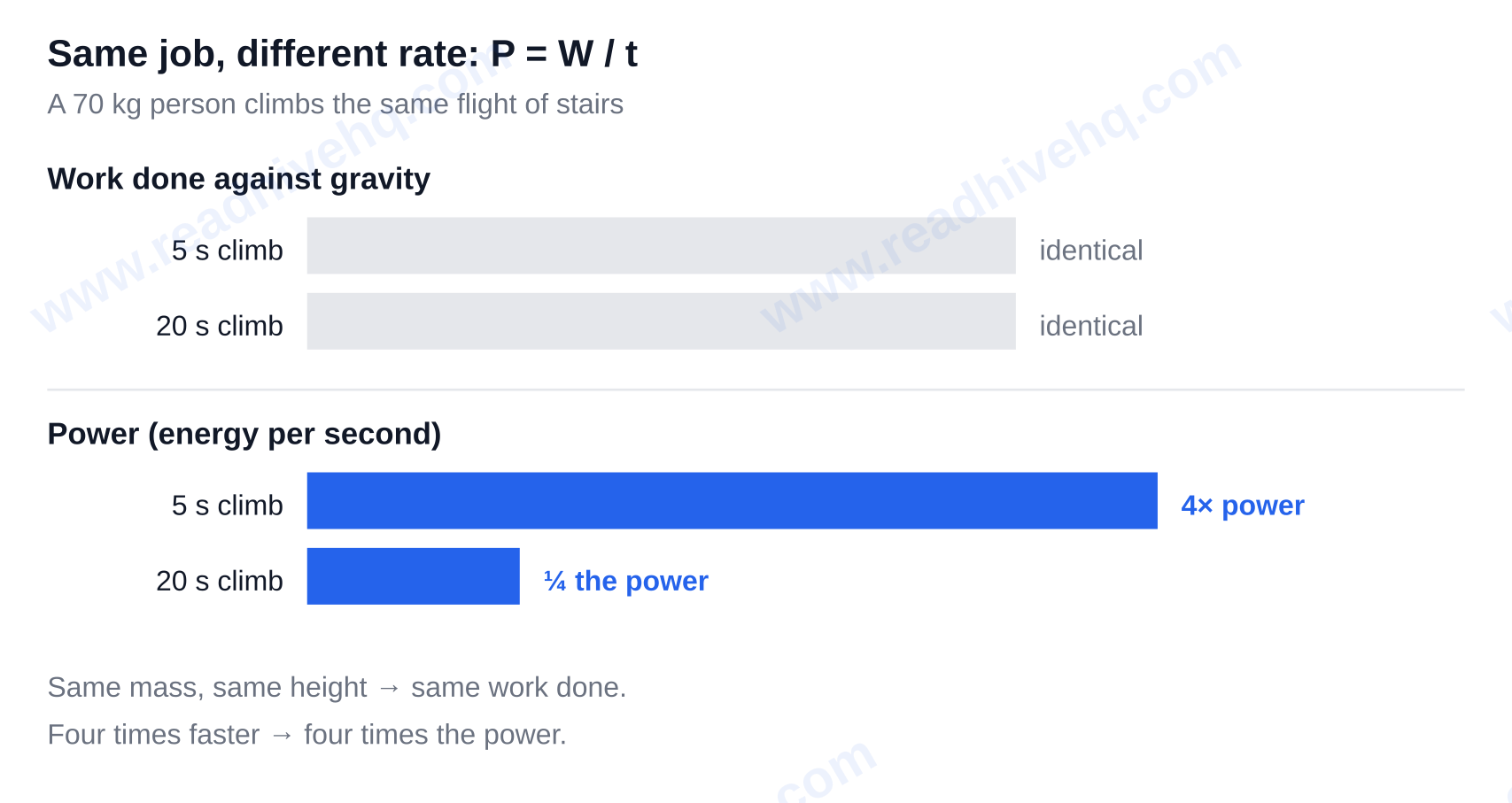
A 70 kg person climbs a flight of stairs. Regardless if it takes 5 seconds or 20, the work done against gravity is identical (same mass and same height). The power is not. Doing it in 5 seconds takes 4x the power, 20 seconds take 1/4 the power. Same job, different rate.
Is power the same as force?
No. Force is a push or a pull and is measured in newtons. Power is how quickly that force does work — P = F·v. A strong person doing a slow push and a weak person doing a fast push can deliver the same power, which is why gearboxes exist.
What is the SI unit of power, and what is a watt anchored to today?
The SI unit is the watt (W), equal to one joule per second, with base units’ kg·m²·s⁻³. It is named for James Watt (1736–1819).
Why the watt now traces to the Planck constant
Most definition pages stop at “a joule per second” — true, but no longer the whole story. Since 20 May 2019, under the revision of the SI, the kilogram is fixed by the exact numerical value of the Planck constant, h = 6.626 070 15 × 10⁻³⁴ J·s. Because the watt is a derived unit built on the kilogram, metre and second, it now traces to a constant of nature rather than to the International Prototype of the Kilogram formerly kept at the BIPM. The current official reference is NIST Special Publication 330, 2019 edition.
Power vs energy: watts vs kilowatt-hours
This is the most common mistake in this topic. Power is a rate, and energy is the total. Watts and kilowatts measure power, and kilowatt-hours, joules, and other energy units measure energy. A 2 kW heater left on for 3 hours uses 6 kilowatt-hours, and the 2 kW never changes, only the total does. That’s also why your appliance label is in watts and your electric bill in kilowatt-hours: the label tells you the rate, and the bill tells you the total.
How many watts are in one horsepower?
There’s no single answer, and this is what confuses people when converting car or motor specs. The Physics Hypertextbook says three horsepowers are in common use, and the unit originated as literal as that. Watt timed horses at the Whitbread Brewery in London, and standardized horsepower at 33,000 foot-pounds per minute.
| Unit | Equal to | Where you meet it |
|---|---|---|
| 1 watt (W) | 1 joule per second; kg·m²·s⁻³ | SI unit; appliance labels |
| 1 kilowatt (kW) | 1,000 W | Kettles, heaters, engine ratings |
| 1 mechanical horsepower | ≈ 745.7 W | UK and US car and motor specs |
| 1 electrical horsepower | 746 W exactly | Electric motor nameplates |
| 1 metric horsepower (PS, CV) | ≈ 735.5 W | European car specs |
| 1 kilowatt-hour (kWh) | Energy, not power: 1 kW sustained for 1 hour | Your electricity bill |
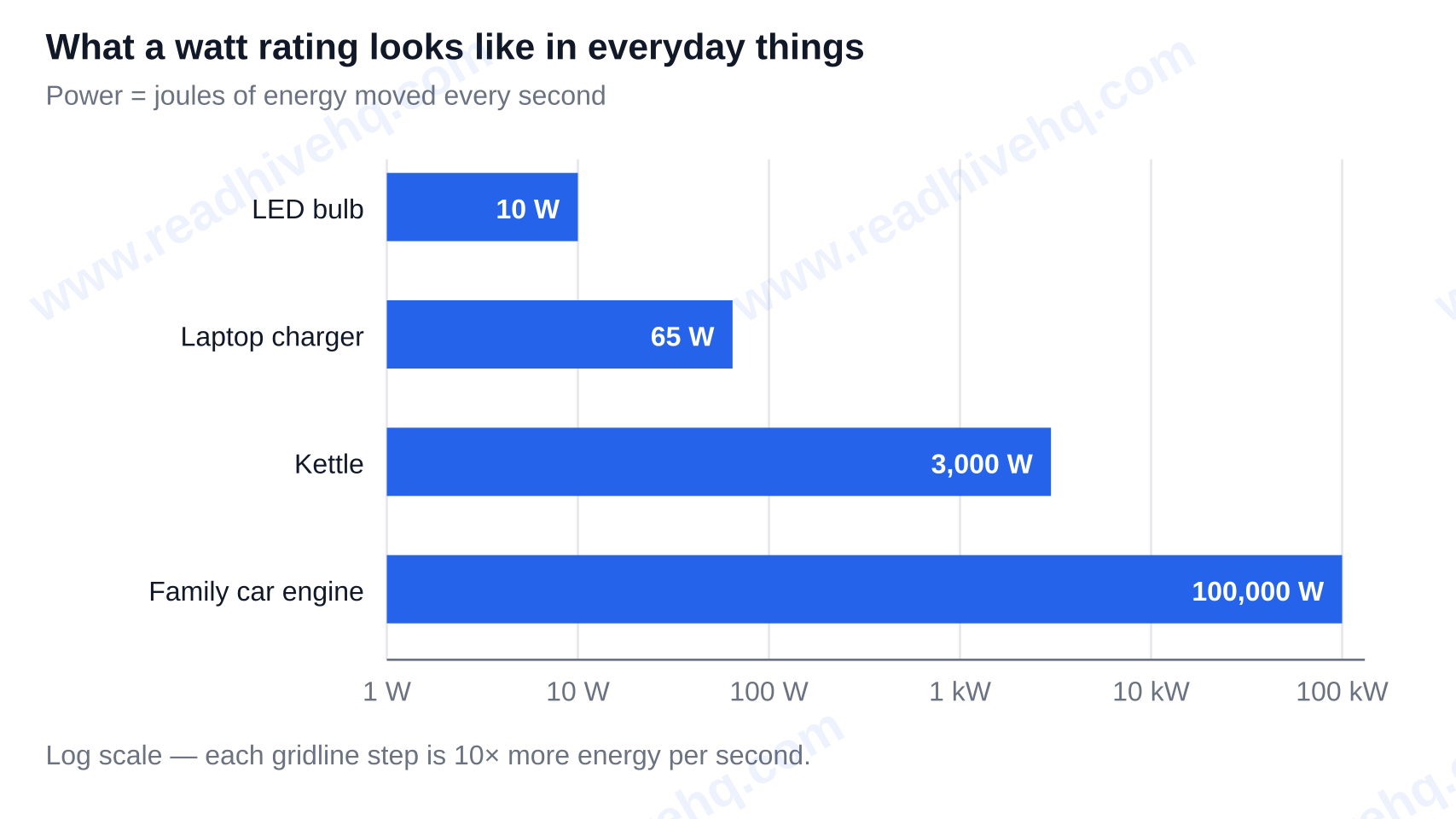
For comparison, the labels you are used to: an LED bulb is around 10 W, a laptop charger around 65 W, a kettle around 3,000 W, and the engine of a family car is around 100,000 W — about 134 mechanical horsepower at 745.7 W apiece.
What is power in sociology and political science?
The definition changes form. Encyclopaedia Britannica defines social power as the capacity to influence, lead, dominate or otherwise affect the life and actions of others in society. It is the ability to affect, or direct, the behaviour of others or the course of events.
Weber’s definition of power
Most courses test this definition. Max Weber said the probability that one actor in a social relationship will be able to carry out his own will despite resistance, regardless of the basis on which that probability rests, is power.
Notice what’s missing. Weber’s definition does not contain any time-related term. Therefore, the “rate of doing work” frame does not apply, and hunting for a formula here is the wrong move. For this, the correct move is to understand the distinction between power and authority.
Power versus authority
For Weber, authority is power that is legitimate. A police officer and an armed robber can both make you stop your car. Only the police officer is willingly obeyed.
The five (now six) bases of power
If this is what you came to learn, this is what you will get. Psychologists John R. P. French and Bertram H. Raven described five bases in the 1950s, and Raven described a sixth in 1965.
- Legitimate — power is associated with the position. As an employee, your manager assigns your task.
- Reward — control over what people want. Who signs off the bonus.
- Coercive — control over penalties. Who can put you on a warning.
- Expert — knowledge that others depend on. The one engineer that understands the legacy system.
- Referent — people want your approval. The colleague that everyone wants to impress.
- Informational — knowledge that others do not have. The one that has the numbers before the meeting.
Why there is no single agreed definition
Be honest with yourself, because the physics-first pages are not: the social sense of power has no settled definition. The Stanford Encyclopedia of Philosophy still approaches the concept of power as contested, addressing it as power as a resource to be redistributed, power as domination, and power as empowerment. Three live readings, not one equation.
What else does “power” mean — maths, electricity and the senses people forget?
Other senses leave readers stranded if nobody names them.
What does “to the power of” mean in maths?
It means exponentiation: “x to the power of n” is x multiplied by itself n times. The third power of 2 is 8. Keep your vocabulary straight. In this case, 2 is the base, 3 is the exponent and 8 is the power.
Power as electricity supply
“The power went out.” “A power cut.” “Powering a house.” This is the youngest meaning on the list, the 1896 meaning, and is a metonym, where the supply takes the name of what it delivers.
Other senses: optical, statistical, legal and political power
- Political and national strength — a “world power” or “superpower” is the aggregate capacity of a state rather than an individual. Start with the social-science treatment above.
- Optical power — strength of a lens, measured in dioptres, the reciprocal of focal length in metres. Your glasses prescription, not your kettle.
- Statistical power — the probability that a given test will detect a real effect, conventionally targeted at 0.80. A study-design concept with no connection to watts.
- Legal power — a delegated authority to act, such as a power of attorney.
- Extraordinary ability — supernatural or superhuman “powers”, the oldest sense still in everyday use.
Ultimately, the answer to what is power traces back to one word: capacity. It is the capacity to do work per second in physics, measured in watts. In social science it refers to the ability to get one’s way in the face of opposition, for which no formula applies. In mathematics, it refers to the capacity to multiply a number by itself. The senses sit together for a historical reason — a 14th-century borrowing from Latin posse, “to be able”, that only picked up the mechanics meaning in 1727 and the electrical one in 1896.
Rule of thumb: power is always “ability per unit of something” — so first ask which ability, then ask per what. There’s plenty more to dig into on Read Hive HQ.