


Most people picture police walking into a home when they hear the phrase search and seizure, and references to the Fourth Amendment reinforce that image. It is only one part of what the Amendment covers. The plain search and seizure definition is that a government agent examines a person, home, vehicle, business, papers, or digital data for evidence of a crime, and takes possession of what is found. The search is the examination. The seizure is the taking. Both have to be reasonable.
A clearer example: an officer searches a glovebox for drugs — that is the search. The officer finds a bag and puts it in an evidence envelope — that is the seizure. Two acts, one phrase; often they happen together, but not always.
The search and seizure definition in plain terms
A search is the examining of a person, house, vehicle, business, papers, effects, or — now — digital information for evidence of a crime. A seizure can mean one of two things. One is the taking of property into government possession and the other is the detention or arrest of a person. Those two meanings share one word, which is where most confusion starts.
The Cornell Law School Legal Information Institute frames the search and seizure definition the same way — the search is the hunt for items connected to suspected criminal activity, the seizure is officers taking possession of what they find.
What is the difference between a search and a seizure?
A search can happen without a seizure, and a seizure can happen without a search. Officers can go through your car, find nothing, and leave. They can also seize without searching first — items in plain view, for example, something sitting on your passenger seat, or an arrest on a street corner. Keeping the two acts separate matters because each is judged for reasonableness on its own.
One more thing worth knowing up front: this is a term of United States constitutional criminal procedure, not a universal legal phrase. Other countries protect the same right through different means. Italy, for example, has Article 14 of its constitution; New Zealand has section 21 of the Bill of Rights Act 1990; the United Kingdom uses stop-and-search powers that vary by jurisdiction.
Defining the phrase is easy. Defining what counts as a search, and what makes it reasonable, is where the law actually lives.

Where the phrase came from: the 1761 writs of assistance case
On its own, the warrant clause of the Fourth Amendment reads like legal boilerplate. Read it against the writs of assistance case of 1761 and it reads like a direct rebuttal.
A writ of assistance was a general search warrant issued by the British American courts. It let customs officials search any vessel or any home, with no probable cause and no individual authorisation — a blank cheque, perpetual and reusable. James Otis argued against the legality of these warrants at the Old State House in Boston in February 1761, and again on 16 November 1761. One of Otis’ lines, which is preserved by the National Constitution Center, is: “It is a power that places the liberty of every man in the hands of every petty officer.”
The resistance to these writs of assistance is what prompted the framers to include the particularity requirement in the Fourth Amendment’s warrant clause.
Why does a warrant have to name a specific place?
Because of James Otis. The colonists’ response to general warrants became the requirement that a warrant be “particularly describing the place to be searched.” It is the main reason why a warrant must specify a particular address, and not just a neighbourhood. It is also why a warrant must name a specific device rather than “all electronics.”
This reasoning is still valid today. In 2024, the Fifth Circuit Court of Appeals described a geofence warrant as a modern-day general warrant, 263 years after Otis made this argument.
What does the Fourth Amendment actually say?
The text, verbatim from Constitution Annotated: “The right of the people to be secure in their persons, houses, papers, and effects, against unreasonable searches and seizures, shall not be violated, and no Warrants shall issue, but upon probable cause, supported by Oath or affirmation, and particularly describing the place to be searched, and the persons or things to be seized.”
There are three main components to the Amendment: the categories of things protected from search or seizure (persons, houses, papers, and effects); the kinds of searches and seizures the State can’t make (unreasonable); and the warrant clause, which carries three separate requirements — probable cause, oath or affirmation, and particularity as to both the place to be searched and the persons or things to be seized.
The word that most readers skim past is unreasonable. The Amendment does not ban all searches and seizures. It bans only unreasonable ones. That makes it a reasonableness rule, not a prohibition — and it is why so much of this area turns on balancing rather than bright lines.
Does the Fourth Amendment apply to state and local police?
Yes. The Fourth Amendment applies to the states through the Fourteenth Amendment. This is not a federal-agents-only rule, which matters because the overwhelming majority of police encounters involve local departments.
What makes a search or seizure “unreasonable”?
Courts decide reasonableness by weighing the interest of the person searched against legitimate government interests such as public safety and crime prevention. The federal judiciary’s own explainer, at uscourts.gov, describes exactly that balance.
The threshold question — was there a search at all — comes from Katz v. United States (1967) and the reasonable expectation of privacy test. It has two parts: an individual needs to actually expect privacy, and society needs to accept that expectation as reasonable. The Court stated the Fourth Amendment “protects people, not places.” That detached the law from physical trespass.
What is a reasonable expectation of privacy?
In practice, a locked phone, a sealed bag, and the inside of a home all qualify. Things that are knowingly exposed to the public generally do not — a shout across a parking lot, a package left on a public bench.
The contested area is information given to a third party, like a phone carrier. Hold that idea; this is where the modern law changed.
When do police need a warrant — and when don’t they?
A warrant is issued by a neutral and detached judge or magistrate, not by the officers who want to conduct the search. In order for a judge to issue a warrant, they need to be convinced that there is probable cause — a fair probability that evidence of a crime will be found in the place named, more than a hunch and less than certainty. A warrant has to precisely describe the place to be searched and the things or persons to be seized, or it risks being void as a general warrant.
In practice, most cases turn on the list of recognised exceptions:
- Consent
- Search incident to a lawful arrest
- Plain view
- Exigent circumstances and hot pursuit
- The automobile exception
- Stop and frisk on reasonable suspicion (the Terry stop)
- Roadside checkpoints
- Border searches
- Administrative and school searches
- The good-faith exception for errors in executing a warrant
The exceptions cover the great majority of searches in ordinary daily life, while warrants cover comparatively few. To work out the likely result in a case, you need to study the exceptions rather than the rule.
The search and seizure definition has moved: from places to data
The traditional definition describes a physical intrusion, such as an officer entering and searching a home, vehicle or business. That version of the search and seizure definition fits a 1791 world, and does not provide an accurate picture of a 2026 problem.
In Carpenter v. United States (2018), the Supreme Court held that obtaining 127 days of a person’s historical cell-site location information from a phone carrier is a search requiring a warrant. No physical space was entered or opened, and nothing belonging to the suspect was touched. The Court, as documented by EPIC, called that location data “detailed, encyclopedic, and effortlessly compiled” and “an entirely different species of business record” from bank records or dialled phone numbers. The ruling narrowed the third-party doctrine that had previously stripped protection from anything handed to a company.
A companion case, Riley v. California (2014), found that police generally may not search the digital information on a phone seized from an arrestee without a warrant. The digital contents of a phone reveal far more about a person’s life than the physical items an arrestee happens to be carrying.
Can police search your phone without a warrant?
Not typically. If the phone is seized during an arrest inside the country, then a warrant is needed, thanks to Riley. It’s a different story at a port of entry. The table in the next section lays out the difference.
The modern question is less “where did the officers go” and more “what information did the officers get, and how much of your life does it reveal.” Apply that to any news story about a phone search, a location warrant, or a data request, and the story makes sense.
What can be searched, and what standard applies
The rows below draw on four different sources — the federal judiciary, the case reporters, CBP, and the Fifth Circuit docket. Taken separately the case law is fragmented; set side by side, it reads as a single decision table:
| What is being searched | Standard that applies | Authority |
|---|---|---|
| Your home | Warrant and probable cause, unless consent, a lawful arrest, exigent circumstances, or plain view | uscourts.gov |
| Your vehicle | Probable cause, no warrant needed; during a traffic stop officers may pat down occupants and run a narcotics dog without individualised suspicion | uscourts.gov |
| A person on the street | Brief detention permitted when unusual conduct suggests criminal activity; frisk on reasonable suspicion | Terry stop |
| A student at school | No warrant needed; the search need only be “reasonable under all the circumstances” | uscourts.gov |
| A phone seized during an arrest | Warrant required | Riley v. California (2014) |
| Historical location history held by a carrier | Warrant required | Carpenter v. United States (2018) |
| The same phone at a port of entry | CBP asserts no warrant and no suspicion required under the border exception | cbp.gov, citing Titles 6, 8 and 19 of the U.S. Code |
| A geofence warrant sweeping everyone near a crime scene | Unsettled and circuit-dependent | United States v. Smith, 5th Cir., 9 August 2024 |
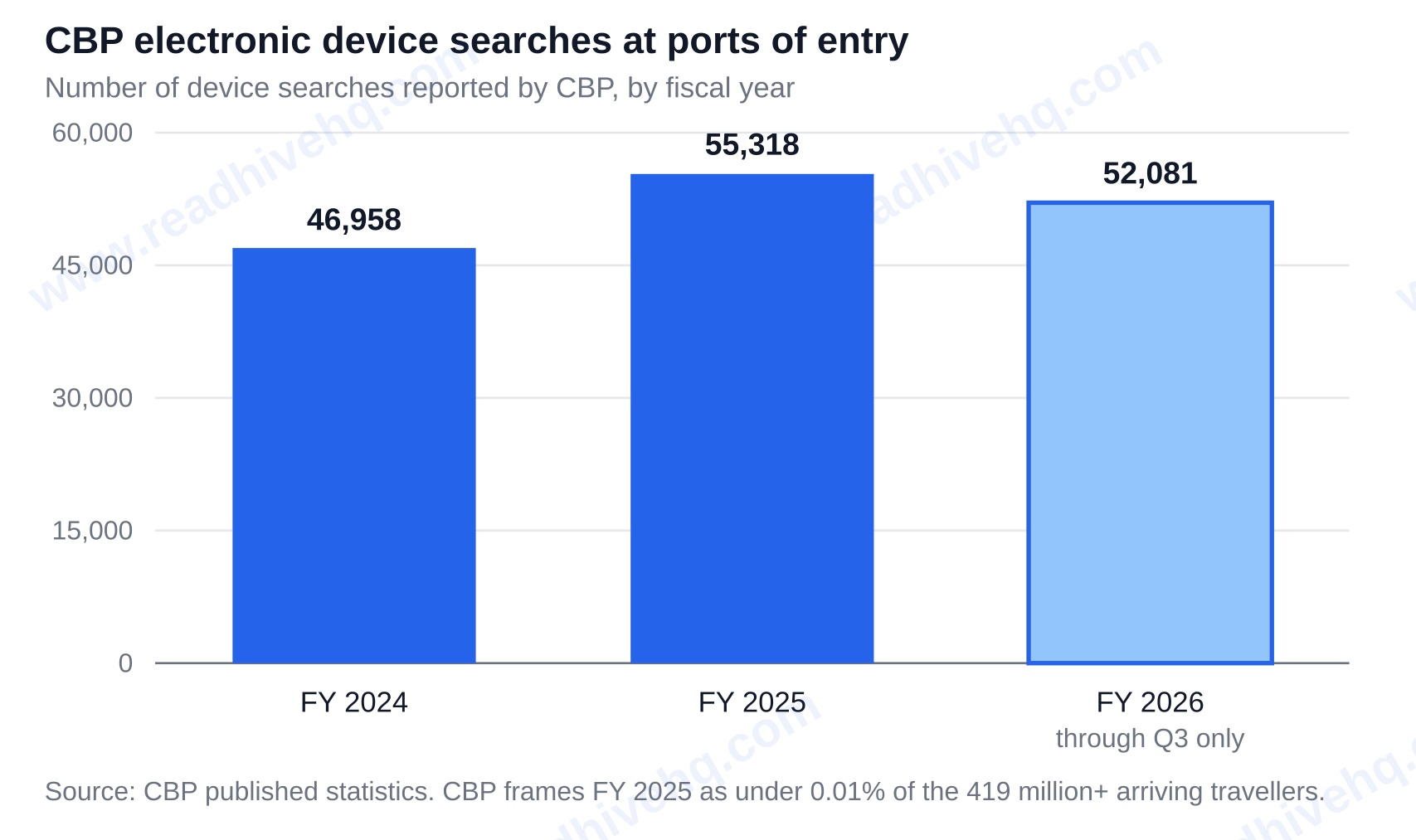
It is worth putting a number on that border row. CBP’s published statistics state there were 55,318 electronic device searches in FY 2025, 46,958 in FY 2024, and 52,081 in FY 2026 through Q3. CBP frames this as under 0.01 percent of the more than 419 million arriving international travellers it encountered at ports of entry in FY 2025.
And the geofence row deserves its own mention. On 9 August 2024 the Fifth Circuit held in United States v. Smith that a warrant requesting Google data on every device within an area of 98,192 square metres around the Lake Cormorant, Mississippi post office during a one-hour window was an unconstitutional, modern-day general warrant. The court let the evidence in anyway under the good-faith exception, largely because geofence warrants were so new. The Fourth Circuit had reached the opposite conclusion about a month earlier.
What happens to evidence from an illegal search?
The basic idea is that illegally gathered evidence is inadmissible against the defendant under the exclusionary rule. With Mapp v. Ohio (1961), the Supreme Court extended that rule to state proceedings, making it relevant in almost all criminal cases rather than just federal ones.
What is the fruit of the poisonous tree?
Derivative evidence — things police found only because of the unlawful search — is typically thrown out as well. The confession prompted by the illegally seized ledger goes out with the ledger.
A search being illegal and evidence being thrown out are not the same thing. The Fifth Circuit found the warrant to be unconstitutional in Smith and allowed the evidence to be admitted. The exclusionary rule is aimed at influencing police behaviour rather than serving as a personal windfall. Suppression motions are decided on a case-by-case basis.
Can you be seized without being arrested?
Yes, and the half-definition that is in wide use gets this wrong. Seizure of a person is often treated as a synonym for arrest, which implies you have to end up in custody. The misreading shows up most often in the fact pattern the public meets in news coverage: someone who is shot at or grabbed by police and gets away.
The U.S. Supreme Court ruled in Torres v. Madrid, decided 25 March 2021 by a 5-3 vote, that applying physical force to a person’s body with intent to restrain is a Fourth Amendment seizure, even if the person never submits and is never subdued. In this case, officers fired at Torres as she drove out of an apartment parking lot, hit her twice, and she escaped. The Court still called it a seizure, holding that the required corporal seizing or touching “can be as readily accomplished by a bullet as by a finger.”
The rule has a limit, and it should not be over-read: force applied by accident, or for some purpose other than restraining, is not a seizure. Intent to restrain is the hinge. Practically, a shot fired to restrain you is a Fourth Amendment seizure. A hand on your arm to detain you is also a seizure. So is a brief street detention.
What are your rights if police want to search your home, car, or phone?
This is a broad overview of the rules to help give you a framework on which to build your understanding; it is not legal advice about any particular encounter. For any live situation, you should contact a lawyer, not read an article online.
Keep the following in mind before you are standing in a doorway:
- You are allowed to refuse consent to a search. Refusing is not admitting guilt and is not cause for suspicion.
- You have the right to ask if the officers have a warrant, ask to see it, and read the warrant to understand what is being granted — the place named and the things listed.
- If you give consent to a search, the warrant is no longer necessary for whatever you consented to. That single fact is why the exception swallows so many cases.
- A car on the roadside and a home at the door are in two separate realms. Be mindful of which realm you are in before you decide anything.
- There is a difference between physically obstructing a search and verbally objecting to one. Objecting verbally preserves the issue; resisting creates a new one.
And the part people get backwards: the determination of the legality of a search is decided afterwards by a court, not at the scene by argument.
The one line to remember
Search and seizure is two acts — the examination and the taking — judged by one test: reasonableness. Most plain-language explanations of the search and seizure definition begin with an officer walking into a home, car, or business, but Carpenter and Riley moved the focus away from where officers go to what information they obtain. The fights now underway over border device searches and geofence warrants are being argued on the ground James Otis stood on in 1761.
Where to go from here: read the Fourth Amendment’s text in full at Constitution Annotated, then work your way through the landmark holdings — Katz, Mapp, Terry, Riley, Carpenter, Torres — at Justia’s search and seizure case index. This way you will be reading the Court’s own words rather than a third party’s summary. For other pieces in this vein, see Read Hive HQ.
Quick Answers
What is search and seizure in simple terms?
It is a government agent examining you, your home, your car, your business, your papers, or your data for evidence of a crime, and taking possession of what is found. The examination is the search; the taking is the seizure. The Fourth Amendment does not forbid either one — it forbids unreasonable ones, which usually means officers need a warrant based on probable cause unless a recognised exception applies.
Can police search your car without a warrant?
Generally yes, if the officers have probable cause. The automobile exception provides that if an officer has probable cause to believe there is evidence of a crime in a vehicle, then the vehicle can be searched without first obtaining a warrant. The federal judiciary’s own explainer notes that during a traffic stop officers may also pat down the occupants and run a narcotics dog around the car without individualised suspicion as to any one person. Your home is governed by much stricter rules.
What is the difference between probable cause and reasonable suspicion?
Probable cause is the higher standard — a fair probability that evidence of a crime will be found in the place named. A judge will not issue a search warrant without it, and it is what officers need to search a car. Reasonable suspicion is less than that. It is based on specific, unusual conduct suggesting criminal activity. That is enough to briefly detain someone and frisk them under Terry, but not enough to justify a full search of a home.
Can police search your bag or phone at an airport or border crossing?
At a port of entry, CBP asserts authority to search electronic devices with no warrant and no suspicion at all, grounding that in Titles 6, 8 and 19 of the U.S. Code rather than in the warrant clause. It happens fairly often. CBP reported 55,318 device searches in FY 2025, 46,958 in FY 2024, and 52,081 in FY 2026 through Q3 alone — with CBP saying that’s under 0.01 percent of the more than 419 million arriving international travellers it encountered in FY 2025.
Does the Fourth Amendment protect you from searches by private employers or landlords?
No. The Fourth Amendment restrains government action — federal agents directly, and state and local police through the Fourteenth Amendment’s incorporation of the Amendment against the states. A landlord entering a unit, or an employer searching a locker, is governed by employment law, your lease, and state privacy statutes instead. The exclusionary rule and suppression motions do not apply to those situations.