

In medical billing, the abbreviation POS is the Place of Service. It is a two-digit code on a professional claim that indicates to the payer the location where the service was provided, for example 11 for a private office or 22 for an on-campus outpatient hospital location. CMS manages and controls the POS code set. In health insurance, the abbreviation POS stands for Point of Service plan.
The following number demonstrates the impact of this field. For CPT 99214, a regular, established-patient visit, 2026 data published by revenue-cycle sources placed the non-facility rate at around $158 and the facility rate at around $116. Same work, same procedure code, two different payments, determined by two digits. The most current numbers for your area can be located in the CMS Physician Fee Schedule Look-Up Tool before you rely on any reproduced number.
What does the POS medical abbreviation stand for?
Place of Service. Nothing more, nothing less.
Place of Service in one sentence
A Place of Service code is a two-digit number that identifies the physical site where the service was provided to the patient. It is neither a diagnosis nor a procedure and it is not a modifier. It describes location only, and it is filed on the same claim line with the CPT or HCPCS code it is associated with.
Who maintains the POS code set
CMS has responsibility for creation and maintenance of the national code set. The latest descriptors are published on the CMS Place of Service Codes page, which indicated a last-modified date of 02/09/2026 at the time of review. CMS states that these codes are required for the electronic transmission of professional claims under HIPAA, through the ASC X12N 837 Health Care Claim: Professional standard. Therefore, on the claims, the field is never blank or optional.
Where the code goes on a claim
- CMS-1500 paper claim: Box 24B, the Place of Service column on each service line (different service lines on one claim may legitimately contain different codes).
- 837P electronic claim: the value assigned for the facility code in a professional transaction (the HIPAA-mandated standard above).
- Institutional claims (UB-04 / 837I): no Place of Service codes on the claim at all. Type of bill and revenue codes are used instead, which creates confusion for staff that has worked in professional services and is transitioning to work in facility-based services.
In all situations, the code must reflect what the record documents in terms of where the patient physically was — not where the practice is headquartered, and not where the clinician was sitting.
POS has five meanings in healthcare — here’s how to tell which one you’re reading
There are five meanings of ‘POS’ in healthcare, and determining which meaning is being used can be difficult. If you did not arrive here from a claim form, Place of Service may not be the POS you met. Billing documents do not include plan type. The insurance glossary never mentions Place of Service. Neither recognizes clinical terms. All five meanings, in one screen:
| What POS means | Field | Where you’ll see it | To tell |
|---|---|---|---|
| Place of Service | Medical billing | Claim line, EOB line, denial letter | A two-digit number next to a CPT code |
| Point of Service plan | Health insurance | Insurance card, plan name, summary of benefits | Sits beside HMO, PPO, or EPO |
| Platypnea-orthodeoxia syndrome | Cardiology, pulmonology | Echo reports, case reports | Oxygen saturation that drops when the patient sits up |
| Parosteal osteosarcoma | Orthopedic oncology | Pathology and imaging reports | A bone surface lesion, usually distal femur or proximal tibia |
| Probability of success | Drug development, biostatistics | Trial design, portfolio and go/no-go documents | A percentage, never a claim form |
The quick context test
Two digits on a claim line denote Place of Service. A plan name or benefits document denote Point of Service. A clinical narrative denotes one of the clinical expansions: a patient desaturating points to platypnea-orthodeoxia syndrome, a skeletal lesion points to parosteal osteosarcoma.
The collision that sends people to the wrong article
The collisions that send people to the wrong article the most are Point of Service and Place of Service. The confusion is heightened because both are billing-related and both are abbreviated the same way. They are completely unrelated. One describes the location of a service on a claim, the other describes how a health plan is structured. A member of a Point of Service plan still generates claims with Place of Service 11 or 22.
The clinical terms billing articles never mention
Platypnea-orthodeoxia syndrome occurs when a patient experiences dyspnea and arterial oxygen desaturation in the upright position, but improves when lying down. It is most commonly associated with a patent foramen ovale, as described in the case literature on PMC. Parosteal osteosarcoma is a low-grade, well-differentiated surface sarcoma that typically occurs in the distal femur or proximal tibia of young adults. If you ever encountered POS in these contexts, no billing page will be of any help to you.
Which POS code should you use? A decision table
CMS publishes the descriptors but not the selection logic. Therefore, this is usually the part that has to be constructed manually. Essentially, two inputs drive the answer: the physical location of the patient, and the owning entity of the site.
| Where the patient was | Who owns/operates the site | POS | CMS descriptor | Pays |
|---|---|---|---|---|
| Exam room | Private practice | 11 | Office | Non-facility |
| Clinic on the hospital campus | Hospital | 22 | On Campus-Outpatient Hospital | Facility |
| Clinic away from the hospital campus | Hospital | 19 | Off Campus-Outpatient Hospital | Facility |
| Admitted as an inpatient | Hospital | 21 | Inpatient Hospital | Facility |
| Emergency department | Hospital | 23 | Emergency Room-Hospital | Facility |
| At home, seen in person | Patient’s residence | 12 | Home | Non-facility |
| Surgical suite, not hospital-based | Ambulatory surgical center | 24 | Ambulatory Surgical Center | Facility |
| At home, on video | Patient’s residence | 10 | Telehealth Provided in Patient’s Home | Non-facility |
| On video, anywhere but home | Any other originating site | 02 | Telehealth Provided Other than in Patient’s Home | Facility |
The full CMS listing runs in excess of 50 entries, and includes settings such as assisted living, schools, correctional facilities, and mobile units. The decision table above represents the common 90% case. Verify anything outside this table against cms.gov and against your payer’s policies. Do not rely on a blog for verification.
POS 11 vs POS 22 vs POS 19: the hospital-owned clinic trap
This is by far the most expensive trap. Billing POS 11 for a service performed in a hospital-owned clinic where POS 22 or 19 should have been billed is the classic error.
- POS 11 (Office): the practice owns the space and absorbs the overhead — rent, staff, supplies, equipment — so the claim pays the non-facility rate.
- POS 22 (On Campus-Outpatient Hospital): hospitals charge a separate facility fee, so the professional claim gets paid the lower facility rate.
- POS 19 (Off Campus-Outpatient Hospital): same facility pricing as POS 22. The split between the two is based on campus geography, not on the service provided.
Why provider-based conversions change the code
Acquisitions are where good practices get this wrong. A private practice, acquired by the health system, keeps the same location, employees and signage, but the correct Place of Service changes on the conversion date. An inflated non-facility payment for a service performed in a facility-based encounter is an overpayment subject to recoupment, not a clerical slip. Determine provider-based status and campus designation with the health system, verify this prior to sending the first claim, and lock the default by service location in your practice management system.
How does the place-of-service field change what a claim pays?
Place of Service is quite specific, not vague. It determines if the Medicare Physician Fee Schedule pays the non-facility rate or the facility rate, for the same CPT code. Non-facility rates incorporate higher practice expense RVUs because the practice supplies the overhead, whereas facility rates strip that out because the overhead is paid by the facility.
That is what the 99214 figures above represent — roughly $158 against roughly $116 on one routine visit, per 2026 figures reported by revenue-cycle sources. If we extrapolate these figures to all established-patient visits, the field quickly moves from data entry to a revenue line, suggesting it should be captured during pre-submission scrubbing rather than during post-denial cleanup.

POS 02 vs POS 10: how do you code telehealth?
One rule governs both codes: the code always describes where the patient is physically located at the time of service, never where the clinician is.
- POS 10 — Telehealth Provided in Patient’s Home: the patient is at home, including temporary lodging where they are staying.
- POS 02 — Telehealth Provided Other than in Patient’s Home: the patient is in a clinic, workplace, nursing facility, or another originating site.
Per CMS transmittal MM12427, POS 10 was added to the national code set effective January 1, 2022, and starting April 1, 2022, Medicare began to recognize it, when the descriptor for 02 was narrowed. While similar in meaning, these codes are not interchangeable, and not only descriptively: POS 10 generally maps to non-facility pricing and POS 02 maps to facility pricing.
The originating site facility fee (Q3014)
HCPCS Q3014 always belongs to the site where the patient is located and not the site of the distant clinician. For CY 2026, PYA reported an increase from $31.01 in CY 2025 to $31.85.
Freshness caveat
Medicare telehealth flexibilities that include the use of non-behavioral telehealth services by the patient in their home without geographic originating-site restrictions are reported as extended through December 31, 2027, which is what keeps POS 10 billable from a residence. Verify against telehealth.hhs.gov and the CMS telehealth FAQ (updated 2/26/26) before you implement this. Modifiers such as 93, 95, FQ, and FR ride alongside the Place of Service code; they do not replace it, and commercial payer policy can diverge from Medicare.
Why did my claim get a CO-5 denial, and how do you fix it?
CO-5 means the procedure code or type of bill is inconsistent with the place of service. CO stands for contractual obligation, so the practice absorbs the denied balance and cannot bill the patient for it.
The exception most pages on the POS medical abbreviation skip: your code can be factually correct and still draw CO-5, because the edit fires on compatibility between the procedure and the setting — an inpatient-only procedure billed with an outpatient location, or an office-only service billed with 21. The location was never the problem.
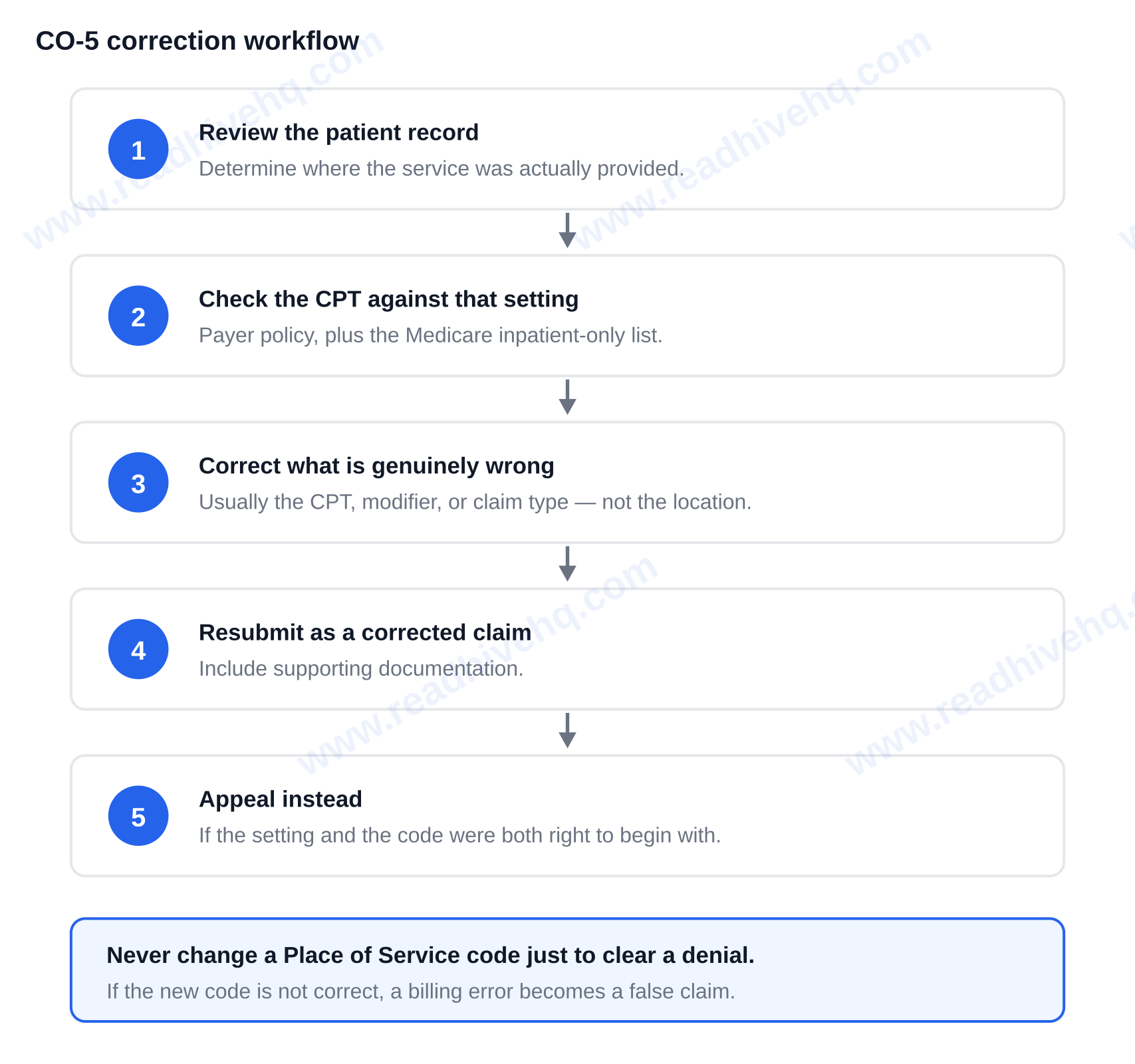
The correction workflow
- Carefully review the patient record and determine the location the service was actually provided.
- Was the CPT permissible in that setting under the payer’s policy? Is the CPT on the Medicare inpatient-only list?
- Correct the element that is genuinely wrong — usually the CPT, the modifier, or the claim type, not the location code.
- Resubmit as a corrected claim with supporting documentation.
- Appeal if the setting and the code were both right to begin with.
The rule to keep you out of trouble is to never change a Place of Service code to clear a denial if the new code is not correct. That is changing a billing error into a false claim.
What is a POS health insurance plan?
If you came to the POS medical abbreviation from an insurance card as opposed to a claim form, this is your answer. According to HealthCare.gov’s definition of a Point of Service plan, it means that you pay less for in-network doctors, hospitals, and other providers, and that you need a referral from your primary care doctor to see a specialist. It is a hybrid: gatekeeping from the HMO side, out-of-network coverage at higher cost sharing from the PPO side.
| Plan type | Out-of-network coverage | PCP referral to see a specialist |
|---|---|---|
| POS | Yes, at higher cost | Required |
| HMO | No, except emergencies | Required |
| PPO | Yes, at higher cost | Not required |
| EPO | No, except emergencies | Usually not required |
Your plan type is on your insurance card and stated in your summary of benefits and coverage. And the crossover worth naming is, the plan type has no effect on the Place of Service code. A member of a POS plan will get a claim with a code 11 or 22 on it.
How do you verify the right code before you submit?
- Confirm the patient’s physical location at the time of service from the documentation, not the scheduling template.
- Confirm site ownership and provider-based status and whether the site is on or off the hospital campus.
- Check the current CMS Place of Service Codes page for the official descriptor. Reproduced lists go stale.
- Review payer-specific policies, since commercial plans and Medicaid programs sometimes deviate from the Medicare set, especially on telehealth.
- See if the CPT code is allowed in that setting. This is what prevents CO-5.
- Make sure the default values for each of your practice service locations are set correctly in your practice management system, and audit them after any acquisition, relocation, or new telehealth program.
The most common errors: defaulting every line to 11, carrying the clinician’s location into a telehealth claim, leaving an acquired practice on its pre-acquisition code, using 02 and 10 interchangeably, and changing the code to clear a denial.
Three things to remember
- The POS medical abbreviation almost always means Place of Service — the two-digit CMS code that describes where the service was rendered.
- Location in combination with ownership determines code selection, and in turn determines facility versus non-facility payment.
- The other meanings announce themselves by context — a plan name, an oxygen saturation finding, a bone lesion.
Next step: open the CMS Place of Service Codes page, confirm the descriptor for every location your practice bills from, and set those defaults before your next claim batch goes out. For other pieces in this vein, see Read Hive HQ.