


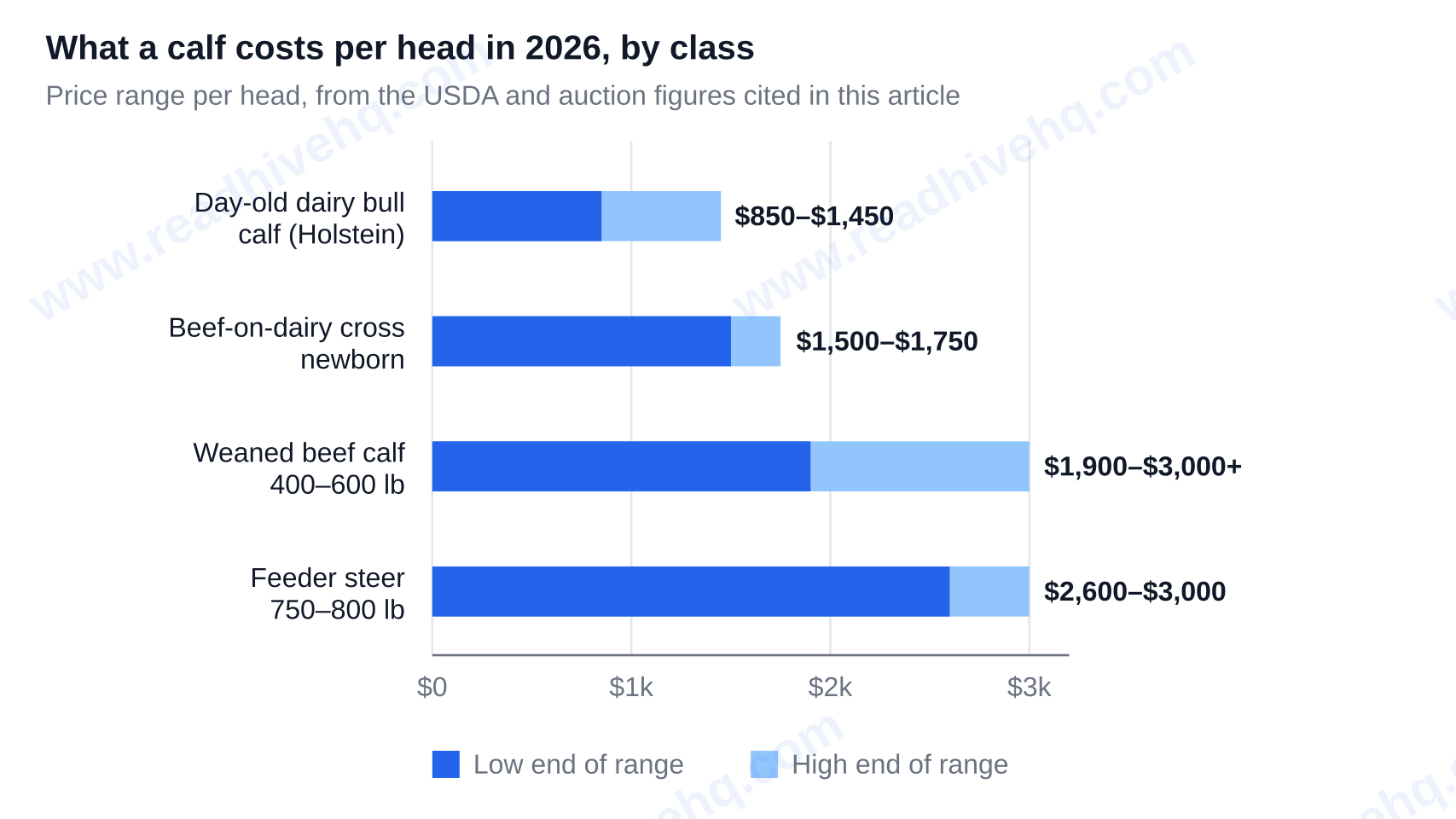
Ready to understand what you’re actually spending on a calf? Let’s break down the real numbers for 2026. This guide covers what every class of calf costs in 2026, how to convert a live market quote into a per-head price, what drives one calf above another, and what the animal costs you after the gavel falls. So, how much does a calf cost? A calf will run you anywhere from $850 to $3,000 per head—and which end of that spectrum depends on what you’re actually buying. A day-old dairy bull calf? Expect $850–$1,450. Beef-on-dairy crosses? Up to $1,500. Weaned beef calves between 400–600 pounds? You’re looking at $1,900–$3,000 or more. The price shifts based on weight, class, sex, breed, health, and where you live.
That range exists because “a calf” really means four completely different animals. Each one comes with its own price tag and its own set of risks.
What does a calf cost right now, by type?
Here’s the thing about calf pricing: cheap and risky go hand in hand. A bargain calf is usually a bargain because someone else gets to do the hard part. Let’s look at the full picture—class, what it costs in 2026, what that means per head, and what you’re really committing to.
| Calf class | 2026 price basis | Cost per head | What you are taking on |
|---|---|---|---|
| Day-old dairy bull calf (Holstein) | $970.01/cwt No. 1 grade (90–130 lb); $825.09/cwt No. 2 grade (85–120 lb), USDA, Sept 2026 | $850–$1,450 | Milk feeding twice daily for 60+ days, scours and pneumonia risk, colostrum unknown |
| Beef-on-dairy cross newborn | Sold per head at auction | $1,500+, up to about $1,750 in strong Wisconsin markets | Same bottle-stage risk as above, on a higher purchase price |
| Weaned 400–600 lb beef calf | Per-head auction ranges, USDA AMS summaries | $1,900–$3,000+ | Weaning and transport stress, but off milk and on feed |
| 750–800 lb feeder steer | Mid-to-high $350s/cwt projected for 2026, USDA ERS | Roughly $2,600–$3,000 | The near-finish feed bill — the biggest ongoing cost of the four. |
Day-old and bottle calf prices
The internet gets this wrong constantly. According to the USDA National Dairy Comprehensive Report for September 2026, 0–14-day-old No. 1 grade bull calves (90–130 lb) averaged $970.01 per hundredweight, with No. 2 grade (85–120 lb) at $825.09 per cwt. That translates to roughly $850–$1,450 per head for newborn dairy bull calves based on USDA AMS auction data.
If you’re seeing quotes for $40–$50 for a day-old calf online, don’t just ignore it—throw it away. Those pages aren’t slightly outdated. They’re off by roughly ten times what calves actually cost. If you built your budget on one of those, you need new numbers today.
In strong Wisconsin markets during 2026, straight Holstein bull calves sat around $800–$1,000 per head. A beef-on-dairy cross from the same dairy? Up to about $1,750. That couple-hundred-dollar premium exists because the cross carries beef genetics on a dairy production cost—exactly what feeder buyers are looking for.
Weaned and feeder calf prices
A weaned 400–600 lb beef calf is the most popular first purchase for small farms, and you’ll pay $1,900–$3,000 or more per head. This animal has moved past milk, is eating solid feed and forage, and has survived the critical first three weeks when most bottle calves face the highest death risk.
Replacement heifer prices
A replacement heifer commands a premium over a steer of the same weight because you’re not just buying pounds. You’re investing in breeding value—calves she’ll produce over several years. That logic flips once you get to feeder weights: steers usually outsell heifers of equal weight because buyers there actually are shopping for pounds of future beef.
How do you convert a $/cwt market quote into a per-head price?
Here’s the piece almost nobody hands you—and the exact calculation that makes every quote you hear actually checkable instead of something you just memorize.
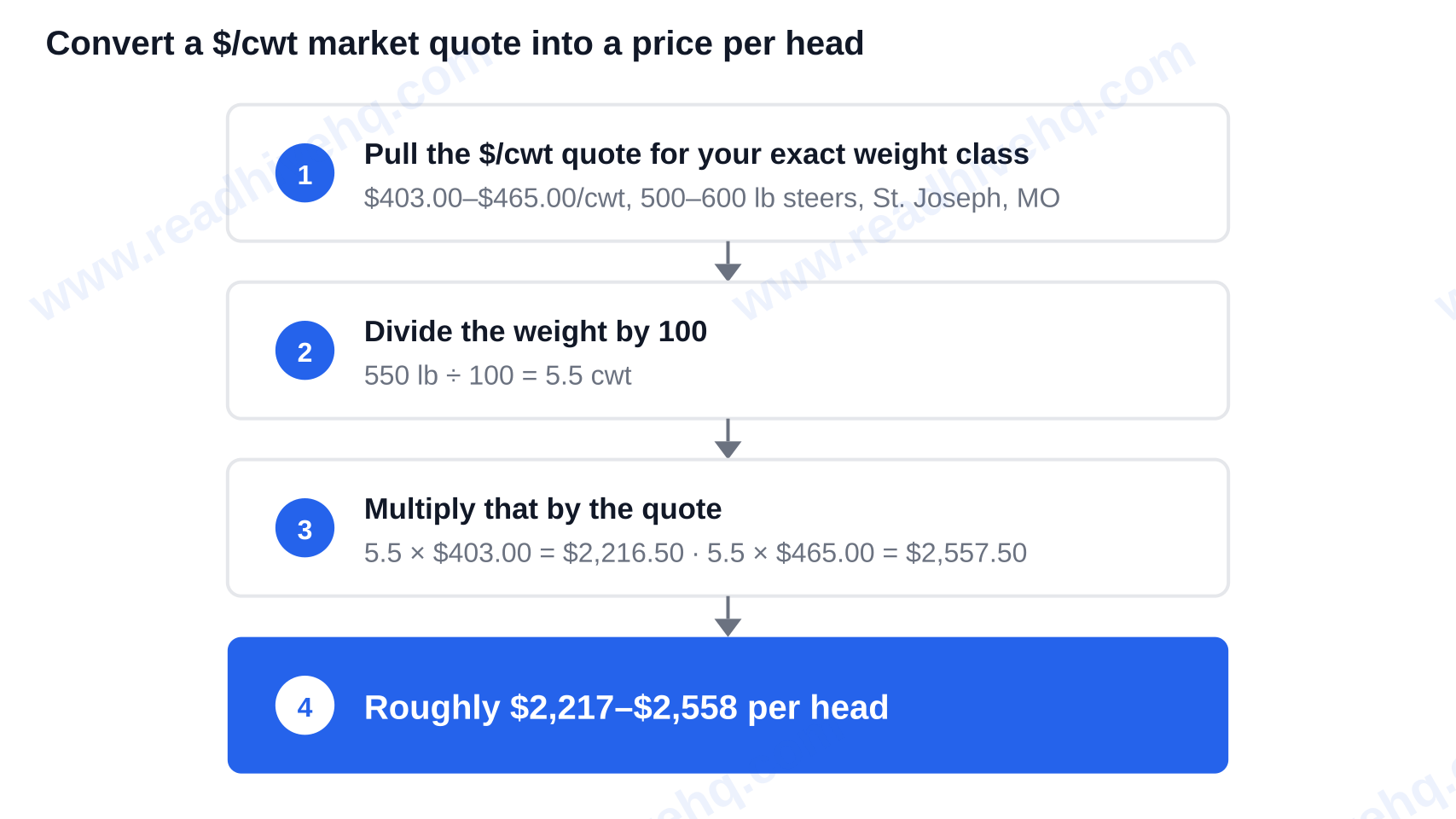
The formula: weight ÷ 100 × $/cwt
(Weight in lb ÷ 100) × price per cwt = price per head.
That is it. A hundredweight (cwt) is 100 pounds. Market reports quote cattle per cwt; auctions pay per head. This formula connects them.
A worked example on a 550 lb steer calf
In October 2026, the USDA AMS National Daily Feeder and Stocker Cattle PM Summary reported 500–600 lb feeder steers at $403.00–$465.00 per cwt at St. Joseph, Missouri. Run a 550 lb steer calf through it: 550 ÷ 100 = 5.5, then 5.5 × $403.00 = $2,216.50, and 5.5 × $465.00 = $2,557.50. So that calf pencils out at roughly $2,217–$2,558 per head.
Cross-check this against another source. Iowa State Extension’s livestock enterprise budget lists a 500–600 lb steer at $4.92 per pound, which puts your 550 lb animal at $2,706.00. Two different methods, two different sources, the same ballpark. That agreement tells you the math is solid.
Now look at how location changes everything. Apache Livestock in Oklahoma reported $358.00–$412.50 per cwt for that same 500–600 lb class in October 2026. At 550 lb, that’s roughly $1,969–$2,269 per head—hundreds below the Missouri range for the identical animal. Geography is not a rounding error in this market.
Where the math breaks down
Two traps catch first-timers, and both cost real money.
- Light calves get quoted per head, not per cwt. Below roughly 100 lb—your day-old and bottle calf range—auctions report per-head pricing. If you try to force a cwt conversion on those numbers, you’ll get something nobody is actually trading at.
- Lighter calves carry a higher $/cwt than heavier ones. This is what the industry calls the price slide, and it’s built into the market. You can’t price a 500 lb calf off an 800 lb quote. Always pull the quote for the exact weight class you’re buying.
Here’s what changes in real life: that one calculation transforms how the sale barn feels. Instead of wondering if a bid makes sense, you hear “four-fifteen” on 525-pounders, multiply, and know in seconds that pen is worth about $2,179 per head—before the bidding starts.
What makes one calf cost more than another?
Same weight. Same day. Same sale ring. Yet calves can be hundreds apart. Here’s what explains the gap.
Weight and the price slide. Lighter calves pull more per hundredweight. A 400 lb calf is worth more per pound than a 700 lb calf, even though it costs less total. Buyers pay for the cheap pounds they can still add.
Sex. Steers typically outsell heifers at equal weight. Bull calves get discounted against steers at feeder weights.
Breed and genetics. Beef breeds sell over dairy. The beef-on-dairy cross earns its premium because it carries beef structure on a dairy calf’s base cost—exactly what feeder buyers want.
Health and vaccination status. Preconditioned calves with two vaccine rounds pull a documented premium. Why? The buyer picks up less pull-and-treat risk.
Weaning status. A calf weaned 45 days before sale already survived the stress break that makes calves sick in the first weeks after purchase. That stress is already behind it.
Frame, condition, and fill. A calf full of feed and water at sale time weighs more today than tomorrow. Experienced buyers discount for fill on sight.
Lot size. Single head discount against uniform groups of ten or more. It’s a structural hit for the small buyer, and budgeting around it is the only option.
Why are calf prices so high in 2026?
Not enough to go around. The national beef cow herd is at multi-decade lows, so fewer calves hit the market each year. That tight feeder supply meets strong packer and consumer demand, and prices stay at historic highs.
The arc is worth seeing. Georgia 500–600 lb steers opened 2025 near $300 per cwt, peaked around $400, and finished around $400. CME feeder cattle futures have traded mid-to-high $350s per cwt in 2026—up roughly $70 per cwt year over year.
The climb is slowing but not reversing. USDA projects a 5% increase in fed-steer prices 2025 to 2026, compared to roughly 20% from 2024 to 2025. The USDA Economic Research Service Livestock, Dairy, and Poultry Outlook projects 750–800 lb feeder steers to average mid-to-high $350s per cwt for 2026.
For you as a buyer, it’s straightforward: waiting for 2020 prices won’t work. Budget to today’s market.
Where should you buy a calf, and what does each route cost you?
Your route changes both price and risk. Pick based on which one you can absorb.
Auction versus private treaty
An auction or sale barn gives you price discovery and instant availability. You also get mixed calves and the highest health risk of any option, and you’re bidding against professional order buyers who do this daily.
A private sale from a local cow-calf producer usually costs more per head but delivers lower risk. You can see the dam, ask about vaccines, and often buy a calf already weaned 45 days—info that often outweighs the price difference for first-timers.
Buying direct from a dairy is the cheapest entry for day-olds and the only place to ask the one question that matters: did this calf actually get colostrum?
An online video auction moves lot cattle by description at scale. Great for truckloads. Tough for one or two head.
How to check your local market price before you bid
Pull the USDA AMS market report for your region and weight class, plus your local auction’s summary. Read them before you bid, not after. Then run that cwt-to-per-head math so you walk in with a number already locked.
One warning across every route: a suspiciously cheap calf almost always signals a problem. Navel infection, scours starting, or a calf that never got colostrum. The discount is the market pricing that risk accurately.
What does the calf cost after you buy it?
The sticker price is the start, not the budget. This is where first-time plans break.
One-time costs: health prep, hauling, paperwork
Health and vaccines run $20–$200 per head depending on protocol. Transport runs $50–$400 based on distance and whether you own a trailer. Receiving setup and paperwork add another few hundred for most single-head buyers.
Cost to raise a bottle calf to weaning
Here’s what almost nobody publishes for consumers: real numbers. Hoard’s Dairyman analyzed it and found $363 per calf average, or $5.34 daily, at an average weaning age of 68.6 days. Operations ranged from $168.21 to $904.03 per calf. That gap is management, not purchase price.
Feed was about 45%—roughly $165 per calf, or $2.40 daily. Milk replacer alone runs up to $37 per 25 lb bag, with 2–3 bags needed for two-month weaning. So $74–$111 of replacer per calf.
Annual cost to keep a calf once bought
Then comes the continuing bill: pasture or hay, mineral, clean water, fence, vet work, and documentation. Most first-time budgets skip this line entirely, and it doesn’t stop. Work out your grazing capacity for one head before you buy, not after. An underfed calf becomes a hay bill very quickly.
Two scenarios make it concrete. A $900 day-old dairy bull calf, plus Hoard’s average rearing cost, health, and hauling, lands near $1,500 all-in by weaning. A $2,400 weaned beef feeder just needs grass, mineral, and basics. The purchase gap was $1,500. By the time both are on grass, it’s much narrower.
Which calf should you actually buy for your setup?
The standard advice—start cheap with a bottle calf—fails exactly for the first-timer it targets. Here’s why, and when to ignore it.
When a bottle calf is the wrong buy
A day-old hasn’t proved it got adequate colostrum. When passive transfer fails, the calf has no meaningful immunity. The Merck Veterinary Manual’s entry on colisepticemia documents that failure as a driver of septicemia and death in neonatal calves. You can’t see it in the ring. You find out in week one.
Scours and pneumonia kill in the first three weeks, and both need twice-daily attention you can’t skip or farm out. The rearing-cost data says the same thing in dollars: $168.21 per calf on the low end against $904.03 on the high end, all driven by management quality.
When a weaned calf is the cheaper animal
The exception rule, straight up: if you have no rearing experience, no isolation pen, and no vet lined up, a weaned 400–600 lb calf at a higher sticker price is usually the cheaper animal by the time it’s on grass. A dead $900 calf costs you $900 plus three weeks of your mornings. A living $2,400 calf costs $2,400.
A bottle calf fits one buyer: someone with dairy experience, proper setup, and genuine availability for 60+ days of twice-daily feeding. That’s you? It’s better economics. Not you? The higher sticker price is buying the part you can’t do yet.
On profit, the honest take at 2026 prices: purchase cost is high enough that your margin depends on feed cost and death loss, not on shopping harder. A small farm raising one or two for its freezer can make it work. A small farm expecting resale profit is competing with operations that buy by the load and feed at scale—a tough match for a single-head buyer.
The three things to take away
One: a calf in 2026 is $850–$3,000, and which end depends on weight, class, and region—not on shopping harder.
Two: there’s a real second bill after purchase. Hoard’s Dairyman puts rearing to weaning at $363 per calf average, plus health, hauling, feed, and annual keep on top.
Three: the right calf is the one that matches your setup, not the one with the lowest sticker. Your next move is concrete: pull today’s USDA AMS National Daily Feeder and Stocker Cattle Summary, find your weight class, and run the cwt-to-per-head math before you call a sale barn. For more like this, explore Read Hive HQ.
People Also Ask
How much does a calf cost at auction compared to buying private treaty?
Auction usually wins on sticker price, loses on risk. Transparent price discovery, instant availability—but calves are commingled, health history is often unknown, and you’re bidding against professional order buyers. Private treaty from a local cow-calf producer typically costs more per head but lets you see the dam, ask about vaccination history, and usually get a calf already weaned 45 days—which removes the stress break that makes calves sick after purchase. For a first buyer, that info often justifies the premium.
Is it cheaper to buy a calf or a bred cow?
A calf is the cheaper buy. In 2026, a calf runs roughly $850–$3,000 per head depending on class and weight. A bred cow or cow-calf pair costs substantially more because you’re buying a proven breeding animal plus the calf she is carrying. The trade: a calf gives you one animal to raise; a bred female gives a calf every year. Freezer beef? Buy a calf. Building a herd? The bred female is the shorter route.
How much does a dairy calf cost compared to a beef calf?
Dairy calves are cheaper at the bottle stage, worth less at feeder weights. USDA’s September 2026 National Dairy Comprehensive Report priced 0–14-day-old No. 1 grade bull calves (90–130 lb) at an average $970.01 per cwt, with newborn dairy bull calves running about $850–$1,450 per head. Straight Holstein bull calves were commonly $800–$1,000 in strong Wisconsin markets. A beef-on-dairy cross from the same dairy? Up to about $1,750 per head, because it carries beef conformation. Weaned 400–600 lb beef calves bring $1,900–$3,000 or more.
How much land and feed does one calf need?
Work out your grazing capacity for one head before you buy—stocking rate varies hard with rainfall, forage type, and soil. The cost side is better documented than the acreage. Feed is about 45% of the cost of raising a calf to weaning—roughly $165 per calf, or $2.40 per day, according to Hoard’s Dairyman. Milk replacer alone runs up to about $37 for a 25 lb bag, with 2–3 bags needed to reach two-month weaning, so $74–$111 per calf. After weaning, the recurring bill is pasture or hay, mineral, and water.
What is the cheapest way to buy a calf?
Buying a day-old dairy bull calf direct from a dairy is the cheapest entry—and it’s the only route where you can ask whether the calf actually received colostrum. But cheapest to buy isn’t cheapest to own. Hoard’s Dairyman data shows rearing a calf to weaning averages $363 per calf, with a spread from $168.21 to $904.03 depending on management. Watch out for a suspiciously cheap calf at any price point—it usually signals a navel infection, scours starting, or a calf that never got colostrum.
Can you make money raising a calf for beef on a small farm?
It’s possible, but at 2026 purchase prices the margin hinges on feed cost and death loss rather than on buying cleverly. With feeder calves at $1,900–$3,000 per head and CME feeder cattle futures in the mid-to-high $350s per cwt, the purchase price absorbs most of the room. Raising one or two head for your own freezer typically works out. Expecting to profit on resale means competing against operations that buy by the load and feed at scale—a hard trade for a single-head buyer.