

Is shoulder pain a sign of a heart attack? Yes, it can be. Shoulder pain, and pain in the arms, neck or jaw can be referred pain from the heart. A dull, deep ache in the shoulder, unchanged by arm movement, and paired with other symptoms like chest pressure, shortness of breath, sweating or nausea, is a medical emergency and requires immediate treatment. Most of the time, pain in the shoulder is caused by injury or overuse of the shoulder muscles.
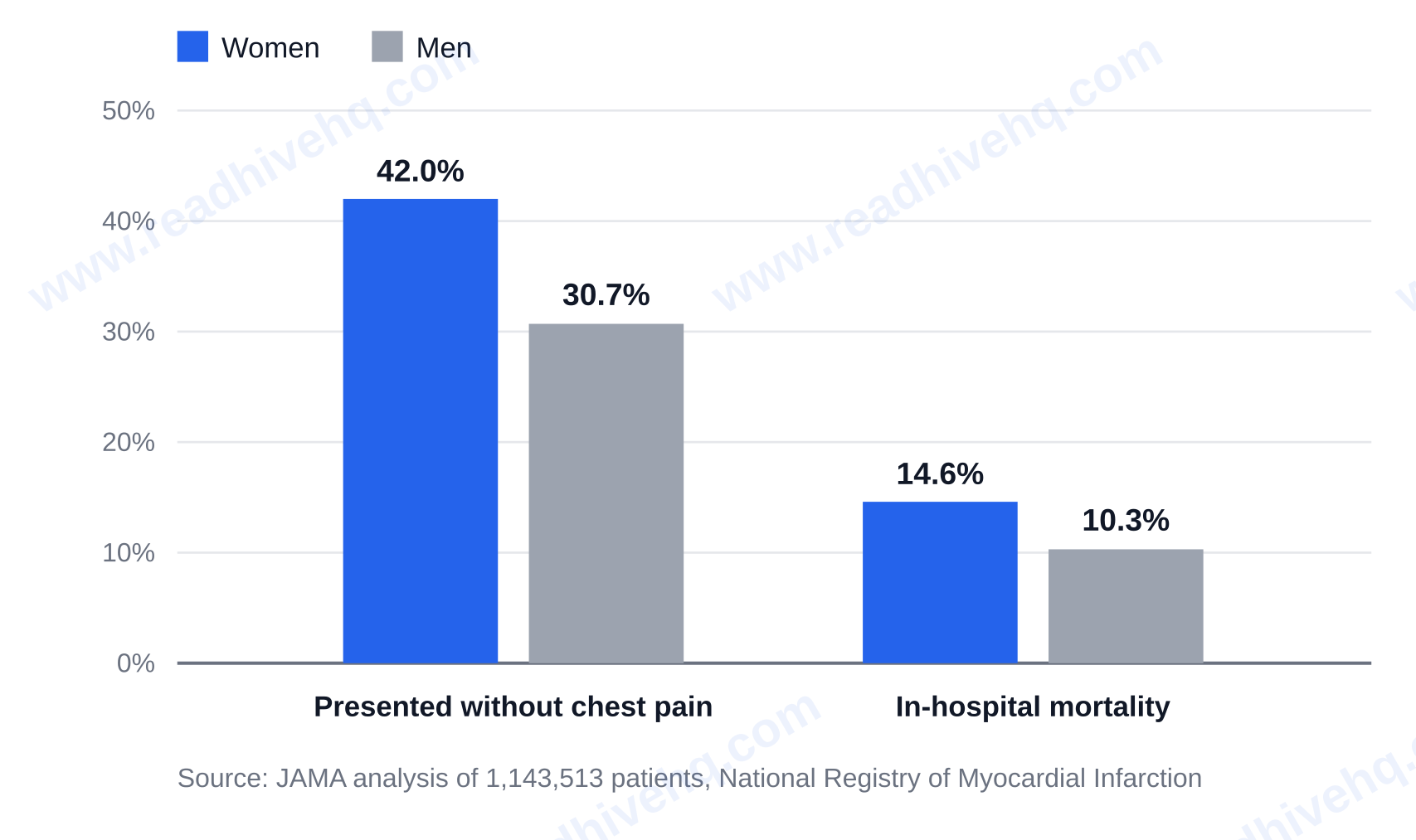
A JAMA analysis of 1,143,513 patients from the National Registry of Myocardial Infarction showed that 42.0% of women experiencing a heart attack presented to the hospital without chest pain, compared to 30.7% of men. In-hospital mortality was 14.6% among women and 10.3% among men. Take some time to consider that, as it turns traditional thinking on its head. Most people believe that heart attacks present with chest pain, and that pain elsewhere must be a different kind of pain, likely a muscle pain. For many people, that is not the case. The shoulder is one of the many locations that pain can be referred to.
Is shoulder pain a sign of a heart attack, really?
It can be, including as the only symptom, though that is uncommon. The American Heart Association lists pain or discomfort in one or both arms or shoulders as one of the core heart attack symptoms. Other symptoms include chest discomfort, shortness of breath, nausea or vomiting, jaw, neck or back pain, and feeling lightheaded, faint or unusually tired. The Mayo Clinic notes pain related to a heart attack can radiate to the shoulder, arm, back, neck, jaw, teeth or upper belly. So this is a fairly standard occurrence, not an outlier.
The other half of the truth also matters. Shoulder pain by itself, with nothing else going on, is more likely to be from a tendon, joint or muscle problem. Both things are true at once, and a decision rule always beats a hypothesis.
Why a heart problem is felt in the shoulder at all
This is referred pain. Nerves for the heart, shoulder, neck and jaw all converge to the same pathways in the brain. If the heart muscle is starved of oxygen, it sends distress signals, and the brain mislocalizes them. It’s something like giving a shoulder pain when in fact there is nothing wrong with the shoulder. The wiring is simply ambiguous.
Worth knowing before you read on: the AHA notes most heart attacks start slowly, with mild discomfort. That slow start is precisely what talks people out of calling. Its advice is blunt — do not wait more than five minutes.
How do I tell if my shoulder pain is heart-related or muscular?
There are 4 tests you can do. Each takes a short amount of time, and you can do them all in under 1 minute. The individual traits listed are scattered around various clinical sources. What follows brings them all together and gives an action to do for each, since a list of traits is almost worthless when you’re trying to compare 5 things and make a judgment under the stress of an emergency.
The four-test triage table
| Test | Points to muscle or joint | Points to the heart | Action |
|---|---|---|---|
| 1. Move the arm — rotate, lift, reach | Pain clearly changes with the movement | Pain is unchanged by arm movement | Unchanged pain plus any companion symptom: call emergency services |
| 2. Point with one fingertip | You can pin it down, and pressing the spot reproduces it | Deep, diffuse, heavy, hard to pin down | Diffuse and deep: treat as cardiac until tested |
| 3. Rest, change position, or take an NSAID (ibuprofen, naproxen) | Eases | Persists, and worsens with exertion or emotional stress | Worse on exertion: stop, sit, call |
| 4. Check the companions | None present | Chest pressure or squeezing, shortness of breath, cold sweat, nausea or vomiting, lightheadedness, jaw/neck/back pain, unusual fatigue | Any single one of these: call emergency services now |
How to read your answers — and what the table cannot do
Three or four answers in the right-hand column, or any one of the red-flag companions, means you should call for emergency services. This is not a case of wait-and-see, or of seeking urgent care. With one of the red-flag companions, you should call for emergency services.
Now the honest limitation. It improves the odds; it does not eliminate. Nothing in this, or any other self-test, can rule out anything. And it is not valid at all for three groups of readers, of which very few discuss.
When the movement test is the wrong test to trust
The loop which is rarely closed: the test you just learned is the one that is incorrect for the most at-risk group. If you are in one of the next three groups, you cannot rely on this test.
Women — shoulder pain may be the whole presentation
Look back to those registry numbers. According to that study, 42.0% of women present without chest pain. This means there is often no chest symptom to validate the shoulder pain against. The AHA also states women are more prone than men to report shortness of breath, nausea or vomiting and back or jaw pain. A 2018 study of 532 people with ST-elevation myocardial infarction (STEMI) found shoulder pain was twice as common in women as in men. The shoulder is not a side show; it can be the main event.
Diabetes, autonomic neuropathy and silent heart attacks
People with type 2 diabetes, due to autonomic neuropathy, can experience loss of chest pain perception, or reduced perception — no pain, or only slight pressure. People with type 2 diabetes may be up to twice as likely to have a silent heart attack, and it is estimated that roughly 1 in 4 heart attacks is indeed silent. An absent chest symptom proves nothing.
Adults 65 and over, and people with hypertension
Silent myocardial ischaemia and atypical presentations of acute coronary syndrome become more prevalent with increasing age and in people with high blood pressure. A similar conclusion applies to people of these demographics: a quiet chest does not rule out a cardiac emergency.
The rule to use instead
Instead of movement-based, use threshold-based. New and unexplained shoulder pain, combined with any shortness of breath, sweating, nausea or unusual fatigue, means emergency services should be called, no ifs, ands, or buts. No need to rotate your arm.
Left shoulder or right shoulder — which side points to the heart?
In general, left shoulder pain is more cardiac in nature, and pain isolated to the left shoulder can signal a heart attack with no chest pain whatsoever. “It’s the right side” should not be used to eliminate the possibility of a cardiac condition, and treating it as one is a real mistake.
Right shoulder pain can have 3 possible causes: cardiac, gallbladder or diaphragmatic referral, or musculoskeletal. The gallbladder reference route is fairly clear: an inflamed gallbladder can irritate the diaphragm, which shares the phrenic nerve pathway with the right shoulder. Its tells are specific: upper right abdominal pain, nausea, vomiting, fever, and discomfort after fatty meals.
Here’s the issue that makes general advice misleading for right-sided sufferers: referred pain from the gallbladder also fails the movement test. It doesn’t change with movement of the shoulder because the shoulder was never the issue. Cardiac pain can also present in the right or both shoulders, especially in women and older adults. Side alone is never the deciding factor. Factors such as the companion symptoms and the fingertip and rest tests are a lot more valuable.
How long does heart attack shoulder pain last, and does it come and go?
Pain from a heart attack is long lasting. Mayo Clinic puts heart attack pain at typically more than 15 minutes, and discomfort that lasts longer than a few minutes should be evaluated rather than monitored.
The dangerous pattern is intermittency. Cardiac symptoms can come and go — pain that eases after a few minutes and returns later still warrants assessment, and easing pain should not be taken as a positive sign. One of the most common reasons people give for arriving late is that “it went away.” The slow, mild start of most heart attacks gives credence to that reason.
There are differences worth holding. Exertion-triggered discomfort that reliably settles with rest may be stable angina — still a cardiac diagnosis, still needing prompt medical review. New, worsening, or at-rest symptoms point towards acute coronary syndrome. Musculoskeletal pain behaves differently again: it is usually associated with a clear injury, overuse episode or specific movement, and follows a day-to-day pattern, not a minutes-long wave.
What should I do right now if you think it’s your heart?
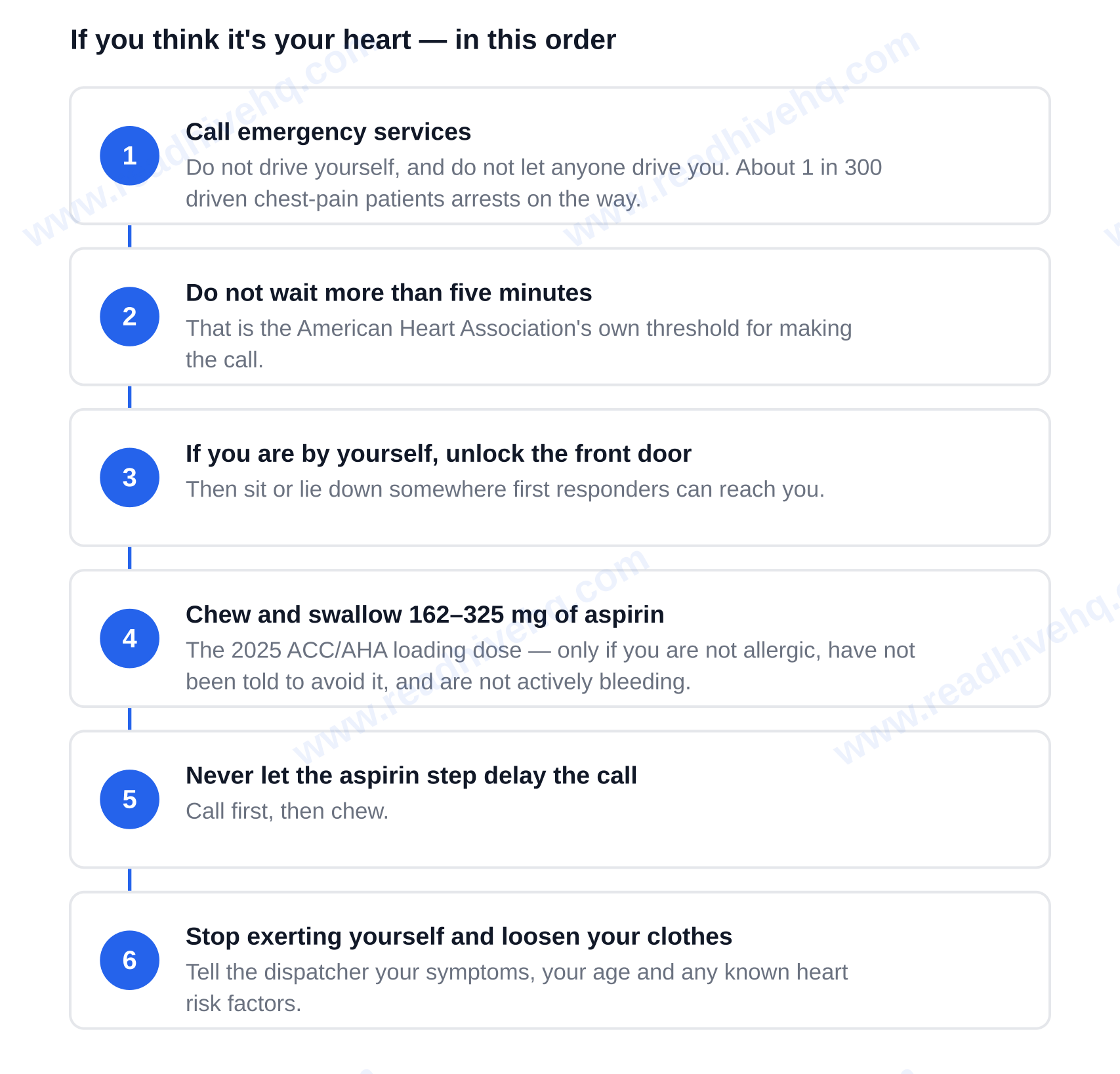
- Call emergency services. Do not drive yourself, and do not allow anyone to drive you — about 1 in 300 chest-pain patients who are driven to the ER by private vehicle suffers a cardiac arrest on the way, and the ambulance is starting treatment the moment it arrives.
- Do not wait more than five minutes to make that call, per the American Heart Association.
- If you are by yourself, unlock your front door, then sit or lie down somewhere first responders can reach you.
- Chew and swallow 162–325 mg of aspirin — the loading dose range in the 2025 ACC/AHA acute coronary syndrome guideline — only if you are not allergic to aspirin, have not been told to avoid it, and are not actively bleeding. Chewing gets it absorbed fastest.
- Never let the aspirin step delay the call. You should call before you do this: call first, then chew.
- Stop exerting yourself, loosen your clothes, and tell the dispatcher your symptoms, your age and any known heart risk factors.
What happens at the ER, and what else could be causing the pain?
Two tests answer the question: an ECG (EKG) and a troponin blood test. That pairing will tell the doctors if the pain is cardiac in nature, and nothing you can do at home comes close to differentiating cardiac from musculoskeletal shoulder pain. Naming them makes the trip finite — this is the specific thing to ask for, and it is also the reason pain that has already resolved still deserves checking.
Non-cardiac causes of shoulder pain
Other cardiac issues such as angina, acute coronary syndrome and pericarditis also need prompt attention. When it comes to the non-cardiac issues, subacromial pain syndrome is the most common cause of shoulder pain in primary care, and incorporates issues such as impingement, bursitis and rotator cuff tendinopathy and tears. The addition of cervical radiculopathy, frozen shoulder, and gallbladder disease accounts for most cases.
When your shoulder pain is almost certainly not your heart
Shoulder pain that comes on right after a specific lift, fall, throw, new workout or an awkward night’s sleep, that is sharp, point localizable, worse on one particular movement, that is reproduced when you press on the area and is not associated with shortness of breath, sweating or nausea, is highly likely to be musculoskeletal. You should see your GP or physio, not call an ambulance.
One caveat. Lower your threshold and get assessed anyway if you are a woman, have diabetes or are over 65, and especially if you have known coronary risk factors.
Get it right: the short version
- Myth: No chest pain means no heart attack. Fact: 42.0% of women in that JAMA registry had no chest pain.
- Myth: If moving your arm changes it, you’re safe. Fact: True for most, but unreliable for women, diabetics and over-65s — and gallbladder pain fails that test too.
- Myth: Right shoulder means it isn’t cardiac. Fact: Cardiac pain can be on the right side, the left side, or both.
- Myth: It eased off, so it’s no big deal. Fact: Symptoms can change and go away, but that doesn’t mean it’s not a cardiac issue.
- Myth: You can figure this out at home. Fact: Only an ECG and troponin test can figure this out.
Generally speaking: Shoulder pain that doesn’t move with the arm and isn’t by itself means you should consider it to be heart pain until proven otherwise with a test. You’ll find more guides like this across Read Hive HQ.