
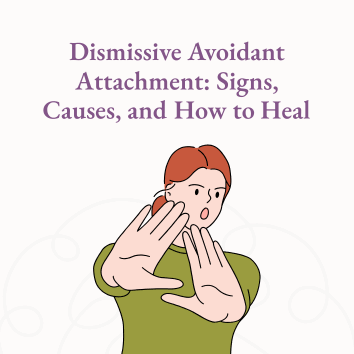
This may be the most common question among people who encounter individuals with traits such as emotionally distant, self-sufficient, and deeply uncomfortable with emotions.
A dismissive avoidant personality is someone who is self-sufficient, emotionally distant, and has distrust of others.
More specifically, a dismissive avoidant is a distant emotionally protective person who distrusts and self-depends.
A dismissive avoidant personality is the result of an extensive need that derives early from emotionally distancing oneself from others and protects that self distanced emotionally.
From early on, the dismissive avoidant individual has learned and/or taught themselves to emotionally distance and self-soothe.
For the purpose of understanding, let it be known that distancing emotionally has the potential to cause great pain and unhappiness.
In distancing themselves emotionally, a dismissive avoidant individual is actually very afraid of revealing their emotional distancing pain in an emotionally vulnerable situation.
Paradoxically, the distancing emotionally protective individual stands to gain much, if not more than others, from emotional closeness.
Within the study of the personalities and the American Psychological Association’s studies on emotional personality types and early relationships, the relationship between emotionally distant personality types and distance protecting personality types is documented.
What Is Dismissive Avoidant Attachment?
How Prevalent Is the Dismissive Avoidant Attachment?
The dismissive avoidant attachment type is one of the four main attachment types that are based on attachment theory.
An individual with a dismissive avoidant personality type has self-sufficient and distanced relationships in which they protect their distanced emotional needs.
People with a dismissive-avoidant attachment style usually feel positive about being in a relationship, but prefer space.
They feel closed off and overwhelmed when emotionally intimate conversations take place and prefer to withdraw.
This does not mean the love is not there. Instead, it means emotionally intimate closeness is difficult for them to engage with.
Characteristics of a Dismissive Avoidant Individual
People who exhibit some traits of a dismissive-avoidant individual have the ability to comprehend relationship dynamics without casting instant negative assumptions on the person.
They are mostly independent and value their personal freedom.
Common characteristics include:
- They prefer to avoid emotionally and deeply personal conversations.
- They prefer a level of emotional intimacy but feel uncomfortable when someone is highly emotionally dependent on them.
- They prefer to emotionally close off during conversations that conflict, but may appear calm on the outside.
- They prefer to work on their problems themselves and have little to no desire to ask for help.
- They feel discomfort when they are emotionally and verbally available to someone while they prefer to diminish the importance of their romantic relationships.
It is very typical for someone that has a dismissive avoidant attachment type to repeat phrases such as “I don’t need anybody”, or “I am perfectly fine by myself”.
These phrases sound very harsh, but really have to do with emotionally caused self-protective behavior that tends to be over time, habitual.
What Causes an Individual to Have a Dismissive Avoidant Attachment Style?
Attachment styles begin to develop as early as childhood/adolescence and happen as a result of parenting styles and how they fulfill a child’s emotional needs.
If a particular parent is consistently emotionally inaccessible, that child eventually will learn to not express their emotions because it ultimately will lead to that child not feeling the need to support anybody else.
As an example, if a child hears the phrases, “stop crying” or, “handle it by yourself”, that child will eventually internalize that they should keep everything to themselves.
With this particular child, he or she will develop an extreme sense of independence that will include an overall hesitance to rely on close friends or romantic partners.
The good news about distinguishable attachment styles is that they are not permanent.
With time, people work on new, healthier emotional habits by being deeply mindful, in conjunction with therapeutic care and supportive relationships.
On the positive side, a large number of dismissive avoidants can identify and understand various unhealthy relational patterns and are able to create and sustain emotionally secure and long lasting relationships.
Dismissive Avoidant and Relationships
Relationships with people that are labeled as dismissive avoidant can become unnecessarily complex and emotionally conflicting, as these types of people will usually alternate between being emotionally available, and then will create emotional and physical distance.
As a result, most partners in this particular relationship type will feel insecure, and that they have actually caused a particular emotional disturbance in the relationship.
Feeling close can be uncomfortable for dismissive avoidants.
It can take time for them to process their feelings.
Distance can be a coping mechanism, and is typically not an indication that they don’t care.
Ways a Dismissive Avoidant Shows Love
- Love may be shown through actions, rather than emotionally expressive words.
- They may love by offering practical support to their partners in difficult situations.
- They may love by showing appreciation for loyalty and commitment, even if being emotionally expressive is difficult for them.
- They have the potential to be very loyal and devoted if they feel enough emotional security in the relationship.
Being in a relationship with a dismissive avoidant may demand high levels of patience as well as a lot of emotional containment, especially in times when they may be showing emotional withdrawal.
It is also likely that the inadvertent side effect of revealing to them the emotional void caused by their lack of expression will happen if you pressure them to express feelings with words before they are ready.
Most typically, relationships which feature more respect and less pressure are the relationships that foster more emotional closeness.
Are Dismissive Avoidant and Avoidant Attachment Styles Similar?
Many people believe that dismissive avoidant styles and avoidant attachment styles are the same.
While both styles of people lack the ability to be comfortable with emotional closeness, dismissively avoidant people will be more self-sufficient.
In contrast, people with avoidant attachment styles may be more fearful of abandonments and rejection.
They may wish to be connected, but fear emotional pain and will keep at a distance.
Dismissive avoidants tend to carry this self-defense mechanism and suppress their emotional needs.
Dismissive Avoidant vs Other Avoidant Patterns
| Dismissive Avoidant | Other Avoidant Patterns |
|---|---|
| Value of independence is stronger | May need emotional connection but fear emotional pain |
| Can conceal emotional needs | May be unsure of emotional needs |
| Can seem emotionally detached/ self-sufficient | Create anxieties in the other with emotional needs |
Being in a relationship with someone who is dismissively avoidant requires an understanding of their situation, rather than pushing them to accomplish a goal that is emotionally draining.
Dismissive avoidants may perceive emotional conversations as them being criticized or controlled.
Important ways to communicate:
- Use constructive statements rather than blame
- Give time to process emotions
- Respect their need for space
- Share feelings with no expectation of a response
- Build trust with consistent and honest actions
Being in a relationship with someone who is dismissively avoidant may be fulfilling and healthy if you can understand their emotional needs.
The goal of the relationship is to safely expand the emotional limits that they can tolerate and not force them to do something they emotionally aren’t ready for.
Can A Dismissive Avoidant Ever Be Secure?
Sure, someone who is dismissive and avoidantly attached can definitely be securely attached.
If someone is especially avoidant to emotional closeness, this can sometimes mean that there is a lack of understanding.
Many people who are emotionally avoidant manage to learn how to effectively communicate and relate with others.
Therapy, reflection, and relationships can help people identify their outdated emotional defensive systems.
Because these emotional defensive systems take time to develop and become ingrained, the same amount of time is required to learn emotional intimacy.
Because emotional intimacy is not an exact science, those who have been emotionally unavailable may find difficulty and frustration while learning emotional intimacy.
Final Thoughts on What Is a Dismissive Avoidant
What is a dismissive avoidant person is way more than just emotionally unresponsive and relationship avoidant.
It is a complex, layered, emotional defensive system designed to preserve separateness and independence.
Although most dismissive avoidants are emotionally unresponsive and distanced, many of them actually do seek emotional closeness and intimacy and do not like to be alone.
Being able to understand emotionally dismissive and avoidant behaviors does and will assist people in relating with and communicating to them more compassionately.
If people do want to work on the emotional defenses, it will be possible to create more emotionally intimate secure relationships.