

There are no male periods. In order to menstruate, you need a uterus and ovaries, and therefore, cisgender men can not. “Man period symptoms” describes a completely different, but also real, phenomenon — irritability, fatigue, food cravings, decreased mood, decreased sex drive — driven by the daily rise and fall of testosterone, clinically low testosterone (below 300 ng/dL), or the load of poor sleep, stress and alcohol.
The symptoms of low testosterone can be characterized in a number of ways, but for this example, we’ll talk about a 34-year-old man. He is okay in the morning, and irritable, fed up and hungry by 5pm, and okay again the next day. He isn’t menstruating. Testosterone levels decrease throughout the day, and so by the end of the day he may be 20–25% less than in the morning — levels measured at 16:00 in men aged 30–40 came in 20–25% lower than at 08:00, according to a Journal of Clinical Endocrinology & Metabolism study on diurnal variation. Again, symptoms are the same. Causes are different.
What are “man period symptoms” and why does the term exist?
PMS is probably the only cyclical mood and appetite change description that is widely published and understood. Because men often feel irritable and worried for no apparent reason, men have borrowed “I’m on my period” to describe their feelings. In men, there is no bleeding, and no cycle behind the symptoms.
The symptoms men report most often
The symptoms described as “man periods” and so-called male PMS are consistent across the board. Those include irritability, fatigue, mood swings, food cravings and constant hunger, anxiety, low libido, depressed mood, mental fogginess, low self-esteem, hypersensitivity, sensitivity about body weight, and self-reported cramps.
What people mean when they say a man is “on his period”
When people say your husband or boyfriend is “on his period,” people usually get the symptoms right and the cause wrong. Irritability and fatigue often strike at the same time every day — a daily schedule, not a monthly one — and are usually accompanied by hunger pangs. These are real symptoms, but there’s no connection to menstruation.
Do men have periods or monthly hormonal cycles?
No. Menstruation is the shedding of a uterine lining after ovulation. There is no uterine lining to shed in men, no ovulation to trigger it, and therefore no menstruation, as explained in Healthline’s explainer on whether cis men have periods.
The daily testosterone curve: morning peak, evening trough
The evidence is clear that testosterone is on a diurnal cycle, peaking around 05:30–08:00 in the morning and dropping around 12 hours later. The 20–25% drop measured in men around the age of 30–40 is relevant for two main reasons: symptoms of “low T” often occur at the same time of day for an individual man, and an afternoon blood test to check testosterone levels can give a falsely low result.
Thus, the so-called “man period” is a misnomer in three main ways: no shedding of the uterine lining, no 28-day cycle, and no reproductive function. One main point of practical application is that if your symptoms occur at the same time every day and are gone after you sleep, they are normal physiology, not cyclical.
Can men get period cramps? Abdominal or pelvic pain in men is not menstrual pain. It should be assessed in the absence of this borrowed label.

Is Irritable Male Syndrome a real medical condition?
It is a useful description, not a diagnosis. Jed Diamond, PhD, defines Irritable Male Syndrome (IMS) as “a state of hypersensitivity, anxiety, frustration, and anger that occurs in males and is associated with biochemical changes, hormonal fluctuations, increasing stress, and changes in male role identity.” Reports have it that men experiencing IMS suffer from fatigue, mental fogginess, depression, anger, low self-esteem and libido, anxiety and hypersensitivity.
The Soay ram study behind the term
The evidence trail is rarely printed. In 2002, Gerald A. Lincoln described irritable male syndrome in his review of animal behaviour, and related it to Soay rams whose testosterone levels fall after the November–December mating season, after which they become nervous and withdrawn and strike out irrationally. Diamond applied it to humans in 2004, in the context of “andropause.”
Why doctors reject “andropause” and “male menopause”
The medical establishment has rejected andropause and its parallel claims to menopause. Perls and Handelsman (2015) argue the condition is overdiagnosed and overtreated under marketing pressures, noting that U.S. prescriptions of testosterone rose from $324 million in 2002 to $2 billion in 2012 — a trail documented in the record of irritable male syndrome’s origins and critiques. Take IMS as a term to label the symptoms. There is no test to verify it and no treatment to relieve it.
Where does the “26% of men” statistic actually come from?
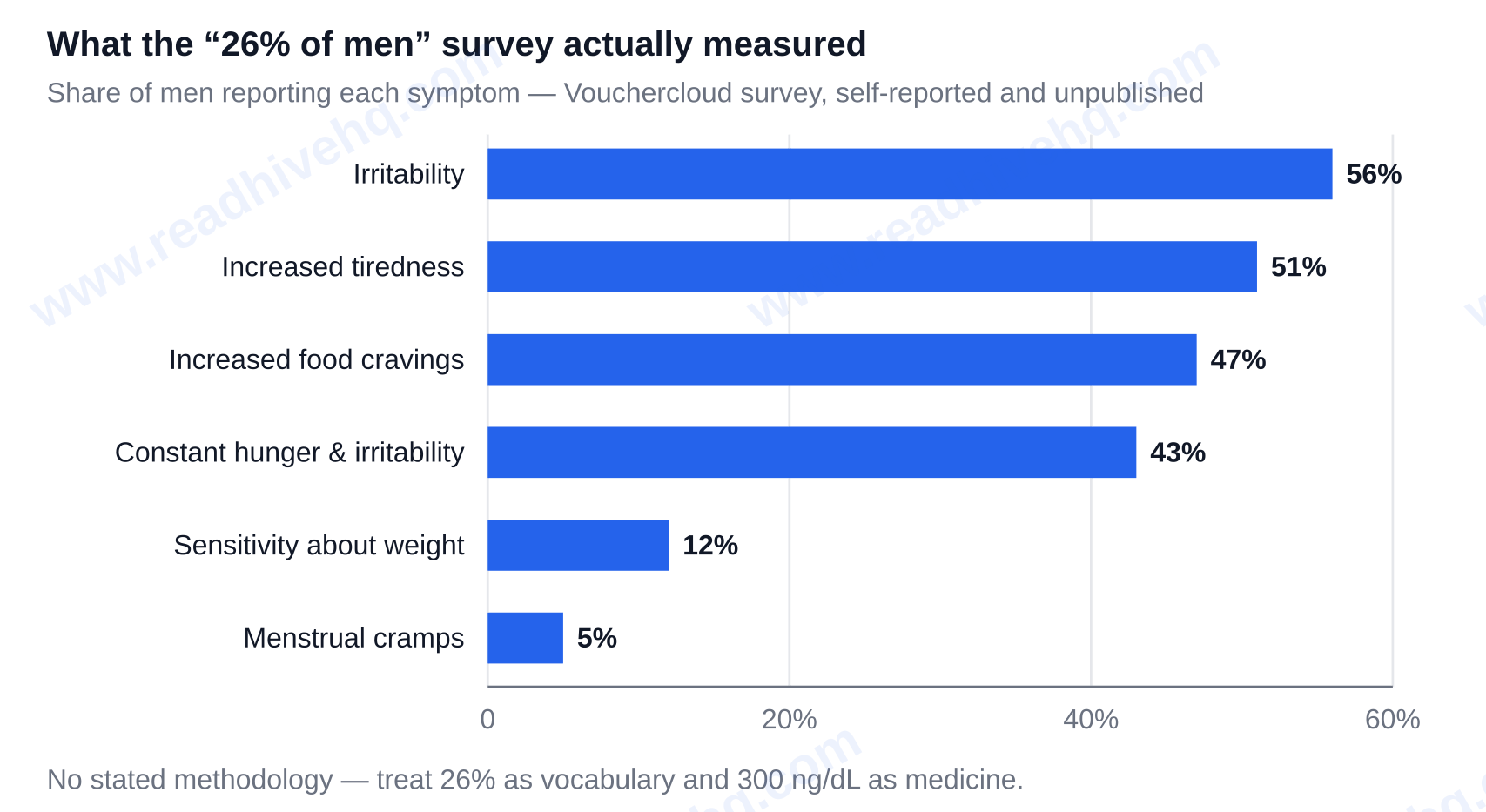
This comes from a coupon website. The number found on nearly every page in the top results for this topic, 26% of men reporting conditions related to the female menstrual cycle, i.e., 56% irritability, 51% increased tiredness, 47% increased food cravings, 43% constant hunger and easy irritability, 12% increased sensitivity about their weight, and 5% reported menstrual cramps, is from a Vouchercloud survey, not a peer-reviewed study. It is self-reported and unpublished, with no stated methodology.
This is important when determining how to use the statistic. A survey by a coupon website tells us what terms men use to describe their own moods. It tells us nothing about the number of men with a hormonal issue.
The number that matters instead: 300 ng/dL (and 250 ng/dL)
As mentioned, the threshold for total testosterone being 300 ng/dL is the American Urological Association figure used by Cleveland Clinic’s guidance on low testosterone and male hypogonadism; however, some of the Cleveland Clinic’s endocrinologists use a stricter threshold at 250 ng/dL. These two facts never appear on the same page: the sites that use the 26% statistic never mention the threshold, and the clinical sites that carry the threshold never talk about “man periods.”
Treat 26% as vocabulary and 300 ng/dL as medicine. Don’t let a voucher poll lead you to getting testosterone therapy.
How can you tell which explanation fits your symptoms?
Four explanations produce this same symptom cluster, and the pattern — not the symptom list — tells them apart. Each source covers one; here they are side by side.
| Explanation | Distinguishing pattern | Test or check | First action |
|---|---|---|---|
| Normal daily testosterone rhythm | Worse late afternoon and evening, better after sleep; tracks the clock | None needed — the timing is the evidence | Fix sleep and meal timing before anything else |
| Clinically low testosterone (hypogonadism) | Persistent regardless of time or circumstance; plus reduced muscle mass, erectile dysfunction, increased body fat | Morning total testosterone blood draw, repeated on a second day | See a doctor for labs and exclusion of other causes |
| Sleep, alcohol, weight and stress load | Tracks the behaviour, not the clock — bad weeks follow bad habits | Honest audit of sleep, drinking, weight and activity; sleep apnea screening | Change the biggest single contributor first |
| Depression or anxiety | Anhedonia and hopelessness dominate over physical symptoms | Screening questionnaire, not a hormone panel | Mental health assessment |
Why an afternoon blood test can manufacture a false “low T” result
When your true morning level is fine, a 16:00 blood draw 20–25% lower can give a reading that is “low T.” Morning draws are recommended to avoid this.
On the third row, Cleveland Clinic’s explainer on declining testosterone levels identifies the contributors as excess weight and elevated BMI, physical inactivity, low-fat or high-calorie diets, chronic and excessive alcohol use, sleep disruption including sleep apnea, and more than 800 endocrine-disrupting chemicals used in plastics and other everyday products. In their July 2025 guidance, the Clinic states that sorting out how much of your symptoms are caused by testosterone vs. lifestyle or another medical condition is a conversation with your doctor along with lab work. These four explanations are stacking, not competing.
When should you see a doctor, and what should you ask for?
These symptoms can include fatigue, decreased muscle mass, decreased sex drive and/or erectile dysfunction, depressed mood, increased body fat. If you have been experiencing these symptoms for weeks regardless of the time of day, book labs: diagnosis is a morning blood draw, a repeat test on a separate day to confirm, then ruling out other conditions with similar symptoms.
Two things should remain in balance. Testosterone falls about 1% per year after age 30. Therefore, gradual declines are expected and do not automatically amount to a diagnosis — though testosterone levels can be low at any age due to numerous causes including obesity, cancer treatment, and/or testicular damage. In general, lifestyle factors should be addressed first. These factors include: alcohol consumption, physical activity (specifically resistance training), body composition, obstructive sleep apnea, and adequate sleep. If testosterone levels are measured and are in fact low, and a man is experiencing related symptoms, then the indication for therapy is met — not symptoms alone. The prescription-spending record above is the reason for caution.
Bleeding is a red flag, never a “period”
There is absolutely no scenario where blood in urine, stool, semen, and/or bleeding from the rectal area is “period blood.” Conditions which result in blood in these areas should be assessed, because many causes are treatable when caught early. You should not self-diagnose and/or self-treat. Get it evaluated!
Which men actually can have periods?
Transmasculine people and transgender men do menstruate, and therefore are the exception to the rule “men don’t have periods.”
Testosterone stops menses for most within six months: median time to cessation on testosterone alone was 151 days, and about 61.7% stopped within three months, and a further 15.5% stopped between three and six months.
Just under one in four take longer than six months, and bleeding or spotting can persist for years on testosterone; gels and creams tend to take longer than injections. The 2024 article published in the International Journal of Transgender Health documented persistent menstruation in people on gender-affirming hormone therapy, so cessation is not universal. Therefore, it is within reason and valid to inform your prescriber of your concerns if bleeding continues after being on testosterone for an extended period.
Ovulation without bleeding, and why contraception still matters
A 2024 finding carries direct practical weight: approximately one-third of amenorrhoeic transmasculine people on testosterone still ovulate. Just because there is no bleeding does not mean there is no fertility, and therefore contraception still applies.
The one thing to remember
The symptoms are real; however, that doesn’t mean menstruation is the explanation. The pattern will give you the explanation. If your symptoms happen at a certain time of the day, that is a clue to normal physiology. Persistent symptoms throughout the day may indicate a lab issue. Situational symptoms may also indicate an issue with your habits. And flat hopelessness points to your mood rather than your hormones. If your symptoms have held steady for more than a few weeks regardless of the hour, go to the clinic and get your total testosterone drawn before 10am, ask for a repeat draw if it comes back low, and it is also important for your doctor to check your mood and sleep at the same visit. If you are actually seeing blood anywhere, don’t do the self assessment and go to the clinic this week. For other pieces in this vein, see Read Hive HQ.
Frequently Asked Questions
What testosterone level is considered low in men?
Healthcare providers generally consider a total testosterone of less than 300 ng/dL low in adult men — the American Urological Association threshold used by Cleveland Clinic. Some endocrinologists at the Cleveland Clinic apply a stricter cut-off of 250 ng/dL. Having one low testosterone level does not make you deficient: testing should be done in the morning and repeated on a separate day. There are several other medical conditions that may mimic low testosterone, so it is important to rule out the other conditions that cause the same symptoms before deciding testosterone deficiency.
Why do my symptoms feel worse in the evening than in the morning?
Because testosterone follows a daily rhythm rather than a monthly one. Levels peak roughly between 05:30 and 08:00 and bottom out about 12 hours later. Levels measured at 16:00 among men aged 30–40 were 20–25% lower than levels at 08:00. This type of daily variation typically leads to symptoms that worsen in the late afternoon and improve after a good night’s sleep. Thus, if your symptoms reliably worsen in the late afternoon and clear after sleep, you are probably looking at normal physiology, not a cycle or a deficiency.
Can a man have period-like cramps without anything being wrong?
Cramping in men is never menstrual cramping, because there is no uterine lining to shed. Abdominal or pelvic pain should be assessed according to its own merit and should not be dismissed as a “man period.” One distinction matters most: urgent medical assessment is warranted for any man who has visible blood in their urine, semen or stool, or bleeding from the rectal area, since that is not a period and many possible causes are treatable when caught early.